Staff Augmentation vs. Outsourcing vs. Managed Services: A 2026 Decision Framework for AI-Generated Code
September 25, 2026

Short answer: Staff augmentation gives you people and leaves AI governance, code review and liability with you. Outsourcing gives you delivery and splits governance contractually. Managed services transfers an entire function, plus its AI operations, to a partner under an SLA. In 2026 the deciding factor is no longer the hourly rate. It is who has the capacity and the mandate to review AI-generated code before it reaches production.
Introduction: the question changed, the comparison articles didn't
A few years ago, choosing an engagement model came down to one question: which model gives us the right people at the right price?
In 2026 that question is incomplete. DORA's 2025 research across nearly 5,000 technology professionals found that 90% now use AI at work, and more than 80% believe it has increased their productivity, while 30% report little or no trust in the code that AI generates. Your engineers, your contractors and your vendor's engineers are all shipping AI-assisted code right now. The difference between engagement models is no longer only who manages the people. It is who governs the machines those people are using, who reviews their output, and who is liable when that output fails.
Most comparison articles on this topic still answer the 2019 version of the question: cost, speed, control, scalability, access to talent. Those factors still matter. They are just no longer where the risk lives.
This article covers: baseline definitions of the three models, what AI agents actually change, how code ownership and review liability differ under each model, a full 2026 comparison table, a decision framework, a real project example, when a hybrid model wins, and a vendor checklist you can use on your next call.
Quick overview: the difference between staff augmentation, outsourcing and managed services
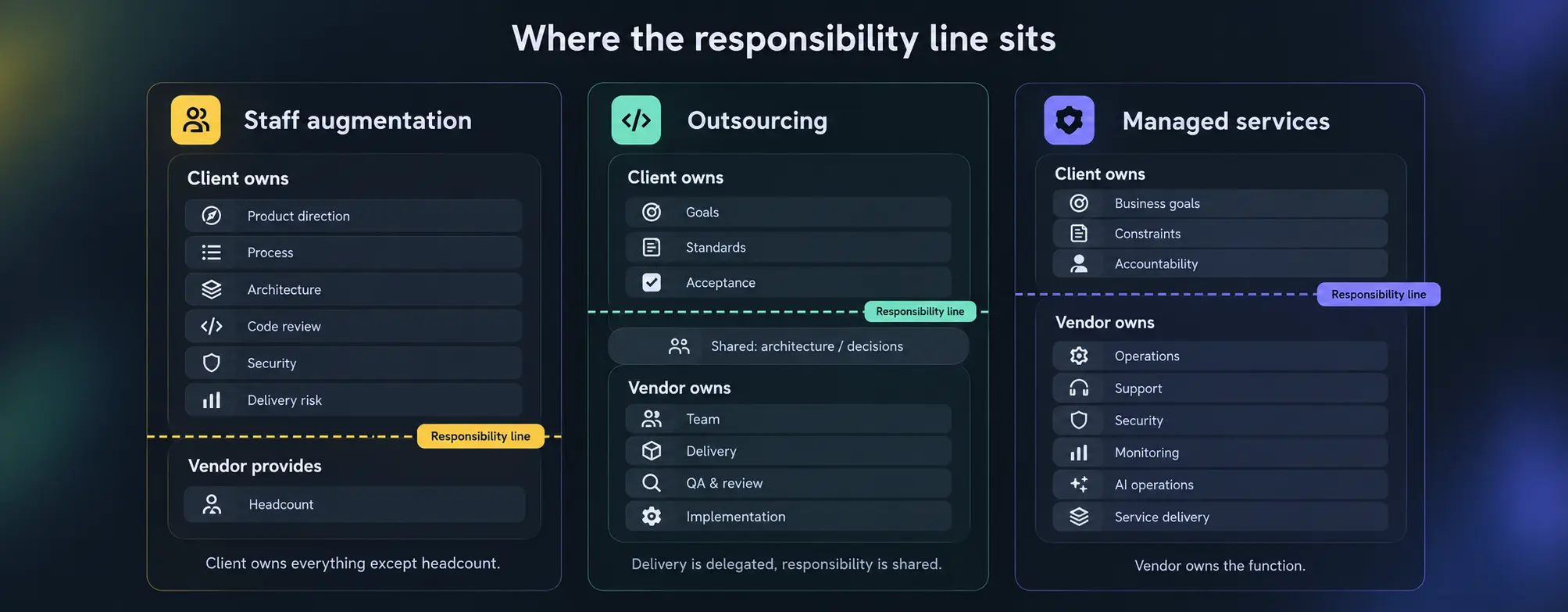
Staff augmentation
Definition: You hire individual engineers who join your team, work in your processes, and report to your managers.
- Who manages the team: you.
- Who owns the process: you (sprints, standards, definition of done).
- Who makes technical decisions: your CTO or tech lead.
- What you're buying: capacity.
Outsourcing
Definition: You hand a scope, a product, a module, an MVP, to an external team that organises its own delivery and returns a result.
- Who manages the team: the vendor.
- Who owns the process: the vendor, within agreed standards.
- Who makes technical decisions: shared, architecture usually agreed, implementation delegated.
- What you're buying: delivery.
Managed services
Definition: You transfer an entire function to a partner who runs it continuously against an SLA, support, DevOps, cloud, security, data platform or AI operations.
- Who manages the team: the vendor.
- Who owns the process: the vendor, end to end.
- Who makes technical decisions: the vendor, within your business constraints.
- What you're buying: an outcome with a service level attached.
| Staff augmentation | Outsourcing | Managed services | |
|---|---|---|---|
| You get | People | A delivered scope | A running function + SLA |
| Team management | You | Vendor | Vendor |
| Delivery risk | You | Shared / vendor | Vendor |
| Typical start | Days | 2–6 weeks | 4–8 weeks |
| Best for | Scaling a strong in-house team | Building or rebuilding a product | Operating something long-term |
Why AI agents change this comparison completely
AI coding agents don't just write code faster. They change the shape of the work, and therefore the shape of the risk.
- Output volume grew faster than review capacity. Analysis of Fortune 50 repositories cited in a 2026 Cloud Security Alliance research note found that AI-assisted developers produce commits at three to four times the rate of their peers, and that by June 2025 AI-generated code was adding over 10,000 new security findings per month across the studied repositories, a tenfold increase from December 2024.
- The defect rate didn't drop to compensate. Veracode's 2025 GenAI Code Security Report tested over 100 large language models across Java, Python, C# and JavaScript and found that 45% of code samples failed security tests and introduced OWASP Top 10 vulnerabilities, with Java the riskiest at a 72% failure rate. Cross-site scripting failed in 86% of samples and log injection in 88%, and Veracode's March 2026 update found the overall pass rate essentially unchanged at around 55%.
- Speed now correlates with instability. DORA's central finding is that AI acts as an amplifier: throughput has improved, but AI adoption still increases delivery instability, suggesting teams are moving faster than their underlying systems have evolved to handle safely.
- Engineers themselves don't fully trust the output. Stack Overflow's 2025 survey found 46% of developers distrust the accuracy of AI tools against 33% who trust them, with only 3% reporting high trust.
Put together, this produces a set of questions that simply did not exist in a 2019 engagement-model comparison:
- Who decides which AI tools are allowed on this codebase?
- Who reviews AI-generated code, and at what depth?
- Who runs security scanning on it, and how often?
- Who records what was AI-generated and by which tool?
- Who absorbs the technical debt that accumulates 3–4x faster?
- Who is liable when an AI-introduced vulnerability reaches production?
The practical consequence: in AI-assisted delivery, the bottleneck moved from writing capacity to review capacity. Adding five AI-augmented contractors to a team with one senior reviewer does not give you five times the output. It gives you a queue, and eventually, unreviewed merges.
Who owns AI-generated code under each engagement model?
Before the model-by-model breakdown, one thing needs separating, because it trips up most contracts.
"Ownership" has two layers, and they don't overlap cleanly.
- Contractual ownership. Your MSA assigns to you all rights in the deliverables. Standard, and still essential.
- Copyrightability. The U.S. Copyright Office's January 2025 report reiterated that human authorship is a bedrock of copyrightability: works entirely generated by AI are not copyrightable, and where a work mixes human and AI-generated content, only the human contributions are potentially protected. The D.C. Circuit affirmed that position in Thaler v. Perlmutter in March 2025.
An assignment clause can only transfer rights that exist. For heavily AI-generated components, what actually protects you is not the IP clause alone, it's trade-secret handling, repository control, provenance records, and vendor warranties. That is a contract-drafting problem, and it lands differently under each model.
Staff augmentation
- Who sets AI tool policy: you. If you don't have one, each contractor brings their own, including tools that may retain your code.
- Who reviews: your engineers. Every AI-accelerated contractor consumes your reviewers' time.
- Who runs security review: you.
- Who documents AI usage: nobody, unless you require it.
- Where liability sits: almost entirely with you. The vendor typically warrants the skill and care of the individual, not the quality of the delivered system.
- Contract essentials: approved-tools list, no-training-on-our-code confirmation, AI-usage disclosure obligation, access scoping.
Staff augmentation is the model with the largest gap between perceived and actual responsibility. Clients feel in control because the contractors sit in their Slack, but control is only real if review capacity and an AI policy exist on their side.
Outsourcing
- Who sets AI tool policy: the vendor, subject to your approval.
- Who reviews: the vendor's own reviewers, before anything reaches you.
- Who runs security review: the vendor, ideally with scanning in CI; you verify at acceptance.
- Who documents AI usage: the vendor, if the contract says so.
- Where liability sits: shared and negotiable. This is the model where AI governance can genuinely be bought rather than built.
- Contract essentials: acceptance criteria that include security gates; warranty on defects; SBOM and dependency provenance; AI-usage policy as an annex, not a verbal promise.
Managed services
- Who sets AI tool policy: the partner, as part of the service.
- Who reviews: the partner, continuously, review becomes an operational process, not a project phase.
- Who runs security review: the partner, on a defined cadence with reporting.
- Who documents AI usage: the partner, as an auditable artefact.
- Where liability sits: with the partner, bounded by the SLA and service credits.
- Contract essentials: SLA metrics that cover quality, not just uptime; incident response for AI-introduced defects; exit and knowledge-transfer clauses.
One thing no model transfers: accountability for business and regulatory outcomes. If you are the data controller under GDPR, or the covered entity under HIPAA, that stays with you regardless of who wrote, or generated, the code.
Comparing the three models across the factors that matter in 2026
| Factor | Staff augmentation | Outsourcing | Managed services |
|---|---|---|---|
| Team management | Client | Vendor | Vendor |
| AI governance | Client (often absent) | Shared, contractual | Vendor, as a service |
| Code ownership (contractual) | Client | Client on acceptance | Client, vendor-operated |
| Code review responsibility | Client reviewers | Vendor reviews, client accepts | Vendor, continuous |
| Security responsibility | Client | Shared, gated at acceptance | Vendor, SLA-bound |
| Compliance | Client | Shared | Vendor operates, client accountable |
| Architecture ownership | Client | Shared | Vendor within constraints |
| Knowledge retention | High (people in your team) | Medium (needs handover clauses) | Low–medium (needs exit plan) |
| Delivery speed | Fast to start, limited by your review capacity | Fast once scoped | Slow to start, steady after |
| Flexibility | Very high | Medium | Low–medium |
| Cost predictability | Low (time & materials) | Medium–high (fixed scope) | High (fixed monthly) |
| Scalability | High for headcount | High for scope | High for operations |
| Technical debt management | Client absorbs it | Negotiable per contract | Vendor, ongoing |
| Documentation | Client's standards | Vendor deliverable | Vendor obligation |
| Vendor accountability | Low | Medium | High |
| Risk distribution | Client-heavy | Balanced | Vendor-heavy |
The three rows that actually decide the choice are AI governance, code review responsibility and technical debt management. Cost predictability and start-up time are real, but they're recoverable mistakes. An unreviewed AI-generated codebase eighteen months deep is not.
Decision framework: which model fits your business?
Start with five questions, in this order.
- Do you have a senior engineer who can review AI-generated code at the volume you plan to produce?
- Do you have a written AI usage policy (approved tools, data handling, disclosure)?
- Is this a product to build, or a function to run?
- How long does this need to survive? Under a year → project. Multi-year → operations.
- Who does the regulator or the board call when something breaks?
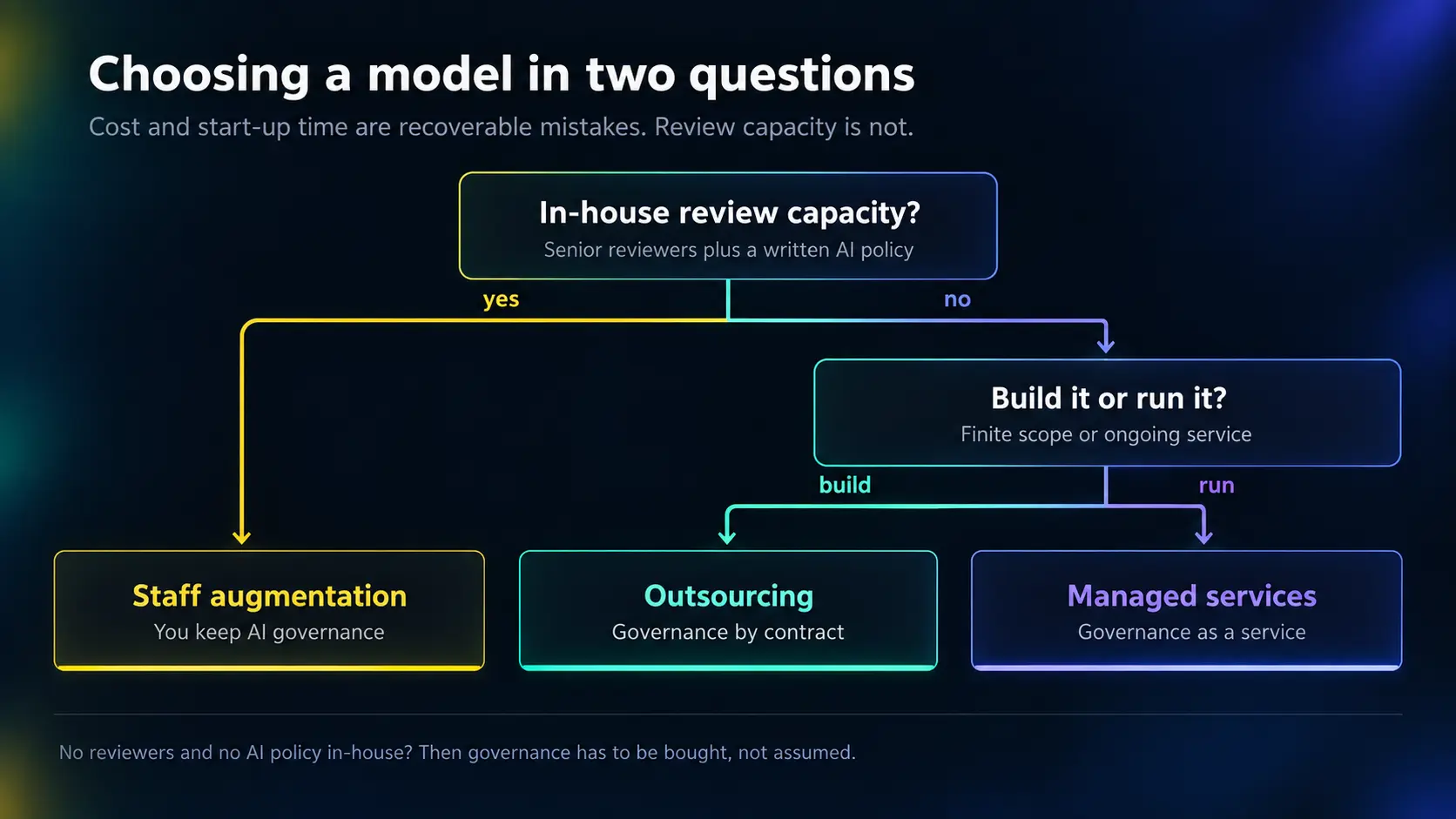
Choose staff augmentation if: you have a CTO and a strong engineering core, your review and CI pipeline already handle AI output, and you need to scale capacity quickly without giving up architectural control. Budget for review time, not just contractor hours, this is the single most common miscalculation.
Choose outsourcing if: you need a product built or rebuilt, you don't have a large internal team, and you want someone contractually accountable for delivery. This is the only model where you can require AI governance from a partner rather than building it yourself.
Choose managed services if: the work is continuous rather than finite, support, infrastructure, security monitoring, AI operations, you need an SLA, and the cost of an incident exceeds the cost of the service.
A real example: from delivery to year-one operations
Product: consumer health and fitness platform (B2C SaaS, web + cross-platform mobile).
Scale: existing early-stage product with live users; six external service integrations, including Fitbit, Suggestic and Stripe.
Stack: JavaScript/TypeScript across backend and clients, third-party health and payment APIs.
The problem. The client had an early version of the product but no engineering capacity to turn it into a scalable platform. Personalised meal planning, nutrition tracking and subscription management all needed building, while performance and stability were already limiting growth. Staff augmentation was on the table, but there was no internal tech lead to manage augmented engineers, and no review process for them to plug into.
What we did. We took the work as an outsourcing engagement with delivery ownership on our side: a personalised nutrition engine, six third-party integrations into a single ecosystem, workflow automation for meal planning and subscriptions, and an architecture and performance pass.
Results. A fully functional MVP in two months. Sub-second platform load times. Six third-party platforms integrated. Then the part that matters for this article, twelve months of post-launch support, which is where the engagement quietly turned into a managed-services arrangement.
Lessons learned. The transition point is where engagement models break. The build contract answered "who writes the code". It did not answer "who reviews and owns the code once the build team's scope closes". We now define that handover explicitly at signature: named reviewers, standards, escalation path, and what the support scope does and does not include.
Applied to AI-assisted delivery today, the same handover gap shows up as: who keeps scanning AI-generated code after go-live? In a pure build contract, usually nobody.
From our own operations. Our delivery process is built around AI coding agents, and we run it on ourselves. Replacing nine paid SaaS tools with internal systems took 315 development hours and produced roughly $47.9K of first-year savings and ~$175K over three years for a 50-person company. The governance point is the same internally as externally: the speed is real, and it only holds because every generated change goes through the same review and security gates as hand-written code. See our case studies for more.
When a hybrid engagement model makes more sense
Most mature companies don't run one model. They run two or three, split by what kind of risk each piece carries.
- Staff augmentation + managed services. Your team builds features; a partner runs infrastructure, security monitoring and AI code scanning. Works when you have engineering strength but no operations bench.
- Outsourcing + internal product team. Your PM and architect own the what; the vendor owns the how and delivery risk. The most common working pattern for funded startups.
- Outsourcing + dedicated AI governance. The build partner delivers; a separate party owns AI policy, provenance and audit. Worth the overhead in regulated domains.
- Staff augmentation + external security review. Cheapest way to close the biggest staff-aug gap: contractors write, an independent reviewer gates.
Hybrids work when the boundary is written down. They fail when two parties both assume the other one is reviewing.
Questions to ask before choosing an AI-enabled technology partner
On AI usage and policy
- Which AI tools are approved on client code, and who approves them? Look for a named list and an approval process, not "whatever the developer prefers".
- Do any of your tools retain or train on our code? Look for a specific tier and setting, in writing.
- How do you audit AI usage across a project? Look for logs or PR-level records, not a verbal policy.
- What governance policies are in place, and can we see them? Look for a document that predates our conversation.
On code review and quality
- Who reviews AI-generated code, and how is it different from reviewing human code? Look for an explicit difference, AI output needs intent-checking, not just style-checking.
- What is your review-to-output ratio as volume increases? Look for awareness that review capacity is the bottleneck.
- How do you measure quality? Look for defect escape rate, change failure rate, not story points.
- What is in your CI gate before merge? Look for SAST, dependency scanning, secrets detection, test thresholds.
On security and compliance
- How do you prevent AI-introduced security risks specifically?
- What happens if AI introduces a vulnerability that reaches production, who pays, and under what clause?
- How do you protect confidential data when using AI tools?
- Do you maintain an SBOM, and how do you handle dependency provenance?
On ownership and liability
- Who owns AI-generated code under your contract, and how do you handle the copyrightability gap? Look for awareness that assignment alone isn't sufficient.
- How are AI-generated changes tracked and disclosed to us?
- Who approves AI-assisted architectural decisions?
On the long term
- How is technical debt measured and paid down in this engagement?
- Who is responsible for documentation, and is it generated or reviewed?
- What does knowledge transfer look like if we end this contract in 12 months?
If a partner can't answer questions 5, 10 and 13 concretely, the model you choose matters less than the fact that nobody is governing the output. Our detailed version of this vetting process is in 45% of AI-Generated Code Has Security Flaws: A CTO's Checklist.
Common mistakes companies make when choosing an engagement model
- Choosing on hourly rate. A cheaper engineer producing 3x the unreviewed output is not cheaper.
- Buying headcount instead of review capacity. The classic staff-augmentation failure in 2026.
- No AI governance requirements in the contract. If it isn't an annex, it isn't a commitment.
- Unclear responsibility boundaries in hybrids. Two parties, both assuming the other reviews.
- No quality criteria. "Working software" is not an acceptance criterion when defect rates shift.
- No security review process. Especially fatal when output volume rises faster than scanning cadence.
- Ignoring knowledge transfer. Managed services without an exit plan becomes lock-in.
- Matching the model to the budget instead of the product stage. Pre-PMF products need outsourcing speed; post-scale products need managed-services stability.
Conclusion and key recommendations
Staff augmentation, outsourcing and managed services are not interchangeable, and they are not a ladder from cheap to expensive. They are three different distributions of responsibility.
In 2026, evaluate them on four things:
- Where AI governance lives, with you, in the contract, or in the service.
- Who reviews AI-generated code, and whether they have the capacity to keep up with its volume.
- How liability is distributed when AI-assisted output fails in production.
- Who absorbs technical debt over the life of the product.
The right model matches your company's maturity and internal expertise, not just your current budget. If you have engineering leadership, buy capacity. If you have a product to build, buy delivery. If you have something that must keep running, buy an outcome. And in all three cases, write down who reviews the machine's work, because that clause, not the hourly rate, is what you'll be reading a year from now.
Sources
- DORA / Google Cloud, 2025 State of AI-assisted Software Development.
- Veracode, 2025 GenAI Code Security Report (and March 2026 update).
- Cloud Security Alliance research note, AI-Generated Code Vulnerability Surge (2026), citing Apiiro repository analysis.
- Stack Overflow, 2025 Developer Survey.
- U.S. Copyright Office, Copyright and Artificial Intelligence, Part 2: Copyrightability (Jan 2025); Thaler v. Perlmutter, D.C. Cir. (Mar 2025).
FAQ
What's the difference between staff augmentation, outsourcing, and managed services?
Staff augmentation supplies engineers who work inside your team and processes. Outsourcing hands a defined scope to an external team that manages its own delivery. Managed services transfers a whole function to a partner who runs it against an SLA. The difference is how much responsibility moves with the people.
Which engagement model works best for AI-assisted software development?
Whichever model puts review capacity next to the AI output. If you have senior reviewers and a written AI policy, staff augmentation works. If you don't, outsourcing or managed services is safer, because AI governance becomes a contractual obligation instead of an internal gap.
Who owns AI-generated code under each engagement model?
Contractually, the client owns the deliverables in all three models under the assignment clause. Legally, purely AI-generated material may not be copyrightable at all, so practical protection comes from trade-secret handling, repository control, provenance records and vendor warranties.
Who is responsible for reviewing AI-generated code?
Under staff augmentation, the client's own engineers review. Under outsourcing, the vendor reviews and the client gates at acceptance. Under managed services, the vendor reviews continuously as part of the service. This is the sharpest difference between the three models in 2026.
Is staff augmentation still the best option in the age of AI?
It's still the best option for teams with strong internal engineering leadership and a working review pipeline. It is the worst option for teams without one, because AI amplifies output without amplifying oversight.
When should I choose managed services instead of outsourcing?
When the work is continuous rather than finite, when downtime has a measurable cost, and when you need a service level rather than a delivery date.
Can I combine multiple engagement models?
Yes, and most mature companies do. Combinations work when the responsibility boundary is written into the contract, particularly who reviews, who scans and who owns technical debt.
How does AI change outsourcing contracts and responsibilities?
It adds a governance layer to the contract: an approved AI tool list, data handling and no-training guarantees, AI usage disclosure, provenance records, security gates in CI, and explicit liability for AI-introduced defects.