It's a Spec Problem, Not a Quality Problem: Why Outsourced Projects Really Fail
August 19, 2026
Oleksandr Shubin | Founder & CEO at SDA
After a failed project, almost every client says some version of the same thing:
"The code quality was terrible."
"The developers didn't understand the project."
It's a natural conclusion. Something got delivered, that something turned out wrong, and the people who built it are the most visible cause. But before accepting that verdict, it's worth asking a different question: were the requirements clear enough to build the right thing in the first place?
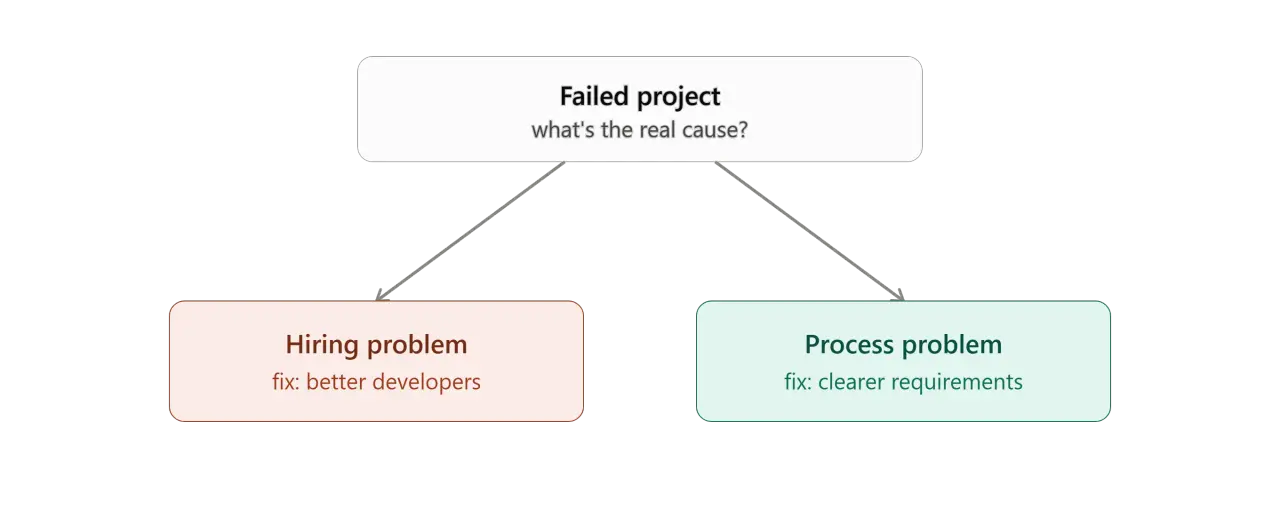
In a large share of failed outsourcing projects, the honest answer isn't "the developers were weak." It's closer to: the team built exactly what was asked for, not what was actually needed. These are two very different problems, and they call for very different fixes.
One is a hiring problem. The other is a process problem, and it usually starts weeks or months before a single line of code is written. This distinction matters because it changes what founders and product managers should actually focus on.
If the real problem is in the requirements, no amount of "let's find better developers next time" will fix it. The most expensive mistakes in software projects rarely happen while writing code. They happen while defining what needs to be coded in the first place.
Do Outsourcing Failures Really Start with Requirements, Not Code?
This isn't just an anecdotal claim. It's a well-documented pattern in software engineering research.
Requirements Engineering (RE) exists as its own discipline precisely because turning a business idea into something a development team can reliably build is genuinely hard. Hard enough that entire academic and industry frameworks are dedicated to it.
A large-scale study of the requirements engineering process in the context of outsourced development, published in PLOS One (via NCBI/PMC), analyzed dozens of recurring problems drawn from academic literature and industry practice. Its authors found that a significant share of outsourcing projects fail to deliver expected benefits, with the failure regularly traceable to the requirements engineering process rather than to code execution.
The same study ranked more than 40 recurring requirements-related problems into distinct categories. That's a strong signal that this isn't a one-off issue tied to a specific vendor, country, or engagement model, but a structural vulnerability in how outsourcing projects typically begin.
A separate study on the human factor in IT outsourcing, published on arXiv, confirms the same conclusion from a different angle. This research on outsourcing success factors points to the transfer of both explicit and tacit knowledge between client and vendor as a central driver of outcomes.
That knowledge transfer is heavily shaped by human factors: client and vendor capability, communication, and engagement. Together, these determine how well both sides actually learn from each other throughout the engagement. In plain terms: outsourcing success or failure largely depends on how well information flows between the people who understand the business problem and the people building the solution, not solely on coding skill.
This pattern shows up outside academic literature too. Long-running discussions on Hacker News about outsourcing, including threads titled "Outsourcing Doesn't Work" and "Why Software Outsourcing Doesn't Work Anymore," keep circling back to the same theme.
Outsourcing gets blamed for quality problems, but experienced practitioners in these discussions often point to a different root cause: clients who couldn't clearly define what they wanted, paired with vendors who never challenged that ambiguity before starting the work.
Together, the research and the practitioner discussions converge on the same point: requirements are where outsourcing projects are usually won or lost, long before anyone opens an IDE.
When Is "Bad Quality" Actually a Specification Problem?
This is where the distinction becomes practical. Many complaints about "bad developers" turn out, on closer inspection, to be a predictable consequence of a vague spec. The classic line is:
"This isn't what we wanted."
And the uncomfortable follow-up question is: did the spec actually rule out the version that got built? Very often, no. The spec was vague enough that what got delivered was a technically valid interpretation of what was written, just not the interpretation the client had in mind.
A few situations make this pattern especially visible:
Why Doesn't the Client Like a Feature That Works Exactly as Described?
The button does what the ticket says. The flow matches the wireframe. And yet the client is unhappy, because the wireframe never accounted for an edge case, a business rule, or an assumption that seemed "obvious" internally but was never written down. The developer didn't fail the task. The spec failed to capture the real requirement.
Why Do Endless Revisions Keep Happening After Development Starts?
The team keeps rebuilding the same screen or flow, not because the first version was technically wrong, but because the requirements keep getting clarified after development has already started. Every round of "clarification" is really a round where the client discovers what they meant, and that should have happened before development, not during it.
Why Does Scope Keep Growing Even When No One Planned It?
Every weekly call adds "just one more small thing." None of these small things looks like scope expansion on its own; each one sounds reasonable and minor. But nobody is tracking the cumulative effect, and there's no defined process for evaluating the change against the original budget and timeline. The project doesn't grow all at once. It grows in small increments that nobody adds up.
Why Does the Team Miss Deadlines Even When Working Fast?
The team isn't slow. The requirements shifted mid-sprint, mid-phase, or mid-release, and the original estimate was built for a different, smaller, clearer version of the project than the one that actually shipped. Blaming a missed deadline on developer pace ignores the fact that the target kept moving.
The common thread across all four situations: if a team keeps "guessing wrong," the more useful question usually isn't "are they competent?" It's "did we actually agree in writing on what we're building?"
What Does a Good Specification Actually Look Like?
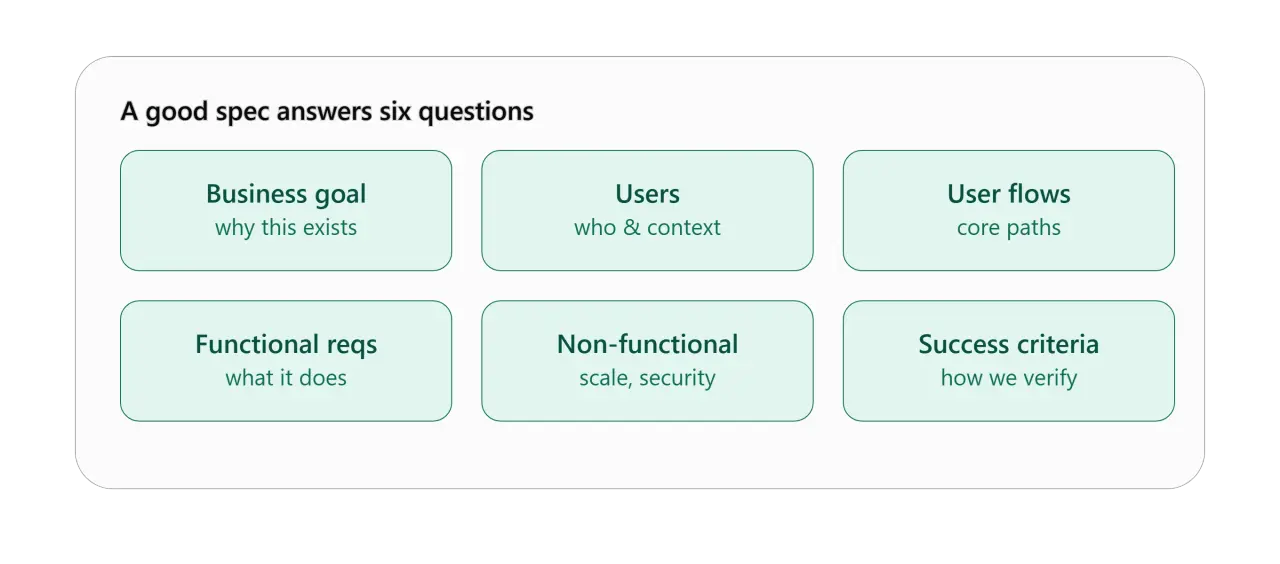
A good specification isn't a 100-page document nobody reads. It's a document, sometimes just a few focused pages, that answers a small set of questions clearly enough that two different developers, reading it independently, would build the same thing.
What Business Goal Is the Product Actually Solving For?
What problem does this product actually solve, and for whom? A feature list without a business goal invites the developer to make assumptions, because there's no way to judge whether a technical solution actually serves the real objective.
Who Actually Uses This System?
Who actually uses this system, and in what context? A spec written for "users" in the abstract usually produces a generic product. A spec written for a specific persona, a warehouse manager checking stock from a phone between tasks versus a finance controller reviewing reports on a desktop, produces very different, far more targeted solutions.
Which Core User Flows Need to Be Mapped?
What are the main paths someone takes through the product to accomplish something real? Flows expose the gaps a feature list hides: what happens if a step fails, what happens if a user backs out midway, what the "unhappy path" looks like.
What Exactly Should the System Do (Functional Requirements)?
This is the most familiar part of a spec, but it's most useful when specific enough to be testable: "the system sends a confirmation email within 60 seconds of checkout," not "the system should notify the user."
Why Do Non-Functional Requirements Get Ignored So Often?
Security, performance, scalability, integrations, compliance. These are often left implicit, which is exactly why they're a typical source of nasty surprises late in a project: a system that runs fine for 50 test users can fall over at 5,000 real ones if scalability was never actually specified.
How Do You Define Success Criteria for Each Requirement?
How does anyone actually know a feature was built correctly? Without clear acceptance criteria, "correct" is left to judgment, and judgment is exactly where client and vendor tend to diverge.
Even a short, structured document that meaningfully answers these six questions reduces risk far more than a long document that clearly answers none of them.
What Spec Template Can You Use Right Away?
This doesn't need to be complicated to be useful. A practical starting template:
- Business objective — why this project exists in business terms, not feature terms
- Problem statement — the specific problem being solved, and for whom
- Target users — who uses the system, and in what context
- User stories — "As a [user], I want [action], so that [outcome]"
- Functional requirements — specific, testable statements about what the system does
- Acceptance criteria — how each requirement will be verified as "done"
- Integrations — third-party systems, APIs, and data sources
- Constraints — budget, timeline, technology, compliance, or platform limitations
- Open questions — what's genuinely still undecided, written down rather than silently assumed
- Out of scope — explicitly what this phase will not include
The last two items do more work than they might seem to at first. Writing down open questions instead of quietly assuming an answer prevents the "we thought you meant X" conversation three months later. And an explicit out-of-scope list is often the single most effective tool against scope creep, since it gives both sides a written reference point to point back to when a new request shows up mid-project.
Case Study: Why an MVP Had to Redo Its Spec Before It Could Be Rebuilt (Anonymized)
Product type: an MVP for a two-sided marketplace platform connecting independent service providers with local customers; the founder described the idea as "like a well-known booking platform, just for our niche."
Stack: React on the frontend, Node.js/Express on the backend, PostgreSQL, Stripe for payments, deployed on AWS.
Scale: a pre-seed startup, a non-technical solo founder, first-time outsourcing experience, an initial budget of roughly $40,000 for version one.
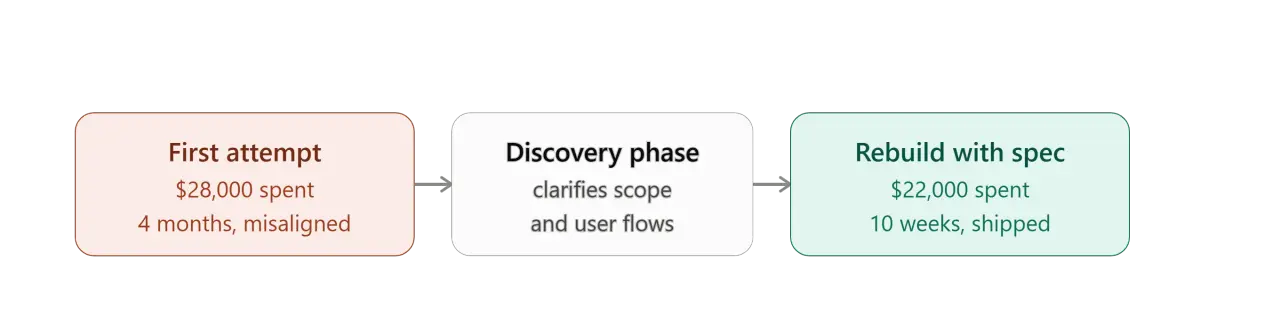
The problem: the founder's initial brief consisted of two paragraphs of description and a reference to a well-known consumer app as inspiration. The first contractor took the brief at face value and started development right away, interpreting "like [reference], just for our niche" at its own discretion. Over four months, the team built booking, messaging, and payment flows that technically worked, but didn't match how service providers in this specific niche actually operate, because nobody had mapped their real workflow before development began. The founder described the outcome as "the developers didn't get it," and the engagement ended with a partially built product and roughly $28,000 spent.
The solution: before restarting development with a new partner, the founder went through a structured discovery process instead of trying "just build it" a second time. That process produced a spec covering the real business model (commission structure, cancellation rules, provider verification steps), two clearly separated user flows for providers and customers, functional requirements written as testable statements rather than a feature list, and an explicit out-of-scope section that excluded a mobile app and multi-language support from the first release.
The result: the rebuilt MVP shipped in ten weeks on a $22,000 budget, lower than the first attempt, because the spec eliminated rework instead of adding functionality. Post-launch change requests were limited to a handful of small UI tweaks rather than structural rebuilds. The founder's own retrospective wasn't "we needed better developers." It was "the second contractor asked far more questions before writing any code," which felt slower in week one but saved months by week ten.
How Do Strong Outsourcing Teams Handle Unclear Requirements?
The difference between a partner and a pure executor usually shows up in the first two weeks of an engagement, not the last two.
A strong outsourcing team typically:
- asks a substantial number of clarifying questions before giving a firm estimate;
- actively probes the underlying business logic, not just the described feature;
- looks for contradictions across different parts of the brief and surfaces them early;
- proposes alternative approaches rather than just implementing the first idea mentioned;
- runs a Discovery or Product Definition phase before locking down scope or timeline;
- is willing to say "we're not ready to start development yet" when requirements genuinely aren't clear.
For a client eager to move fast, this can feel like friction, as if the vendor is stalling instead of shipping. In practice, this phase is exactly what prevents a far more expensive alternative: months of development followed by a rebuild. A week of structured questions is a small price compared to a quarter of misdirected engineering effort.
What Red Flags Should You Watch for Before Signing an Outsourcing Contract?
Some warning signs are visible before the contract is even signed, if you know what to look for.
Why Is It Risky If a Team Gives an Exact Estimate Right Away?
A team that returns a fixed price and timeline within minutes of a two-paragraph brief, without a single clarifying question, is either extraordinarily lucky or not planning to think through the real scope of work. Neither option is a good sign.
What Does It Mean If No One Challenges Your Assumptions?
If every idea you bring meets instant agreement, no pushback, no "did you consider," no "that might conflict with X you mentioned earlier," the vendor is optimizing for a fast "yes" rather than a workable product. Founders and product managers aren't always right about every technical or product decision, and a good partner will say so.
Why Is Skipping the Discovery Phase a Warning Sign?
Going straight from the first call to the start of development, without any structured phase to map business logic, user flows, and requirements, almost guarantees that gaps will surface mid-project instead of before it.
What Happens If There Are No Clear Acceptance Criteria?
If there's no agreement on how "done" will be judged for each requirement, both sides fall back on informal, unstated expectations, and those are exactly the conditions that later produce "this isn't what we asked for" disputes.
Why Isn't an "Everything Included" Proposal Always a Good Sign?
A proposal with no defined boundaries and no change management process sounds generous, but it usually means scope isn't actually being tracked, which makes it much harder to tell a legitimate new requirement apart from scope creep once the project is underway.
None of these signals is necessarily a dealbreaker on its own. Together, they're a strong predictor of a project that will run into the same "bad quality" complaints described at the start of this article, for reasons that have nothing to do with anyone's coding skill.
What Actually Changes: A Vague Brief vs. a Structured Spec
| Factor | Vague Brief | Structured Spec |
|---|---|---|
| Initial estimate | Fast, but assumption-based | Slower to produce, but grounded in real scope |
| Mid-project changes | Frequent, often contested | Logged and evaluated against a baseline "out of scope" |
| Definition of "done" | Left to judgment | Explicit, testable acceptance criteria |
| Client-vendor alignment | Assumed, rarely verified | Verified during Discovery, before development starts |
| Rework | Common, often unbudgeted | Reduced, since ambiguity was resolved earlier |
| Scope creep risk | High, no reference point to appeal to | Lower, the out-of-scope section gives both sides a shared baseline |
Successful Projects Start with a Shared Understanding
The best outsourcing teams don't just write good code. They help the client articulate the real problem, test assumptions before they become expensive, and build a shared picture of the product before the first sprint even starts. A weak spec leads to costly changes later, no matter how skilled the developers are: strong engineering can't compensate for an unclear target.
Getting alignment right at the start is almost always cheaper than fixing misalignment after launch. This isn't a sales pitch for slower projects. It's the same conclusion that research, practitioner discussions, and most post-mortems of failed outsourcing projects independently arrive at.
If you're planning to bring on an outsourcing partner, or you've already had a project go sideways and aren't sure whether the cause was execution or requirements, our Product Discovery / Technical Planning Session exists to answer that question before real budget is on the line. During this engagement, our team helps you:
- structure your business requirements into something a development team can actually build against;
- define a realistic MVP scope;
- map the core user flows your product actually needs;
- turn that into a working technical specification;
- assess risk and budget before development starts, not after.
The goal of Discovery isn't to add more work to the project. It's to remove the most common source of costly, avoidable rework before it happens.
FAQ
How do you know if a project failed because of weak developers or bad requirements?
Look at what actually got built. If the delivered feature technically matches what was written in the brief or ticket but still doesn't meet your expectations, that's usually a requirements gap, not a skills gap. If the delivered feature doesn't even match the written spec, that's more likely a genuine execution problem.
Isn't asking a lot of questions upfront just a way to bill more hours?
It can be, which is why it's worth distinguishing unstructured open-ended questions from a structured Discovery phase with a defined output, a spec document, user flows, and acceptance criteria. The latter has a clear deliverable and a natural endpoint; the former doesn't.
How detailed does a spec really need to be for a small MVP?
It doesn't need to be exhaustive, but it should at least briefly answer the core questions covered in this article: business goal, users, flows, functional requirements, non-functional requirements, and success criteria. A two-page spec that covers all six points is far more useful than a twenty-page document that covers only one.
What if requirements genuinely need to change as we learn more about our users?
That's normal, especially for early-stage products. The goal isn't to freeze requirements forever, it's to have an explicit process for evaluating and approving changes, instead of letting scope informally drift through weekly calls with no record of what changed or why.
Should a non-technical founder be able to write a spec on their own?
Not necessarily, and that's fine. The business goal, target users, and problem statement are usually best defined by the founder; functional and non-functional requirements are often best worked out jointly with the outsourcing team during Discovery, since they require technical judgment the founder may not have yet.
How long should a Discovery or Product Definition phase take?
It depends on project scale, but for most MVP-level projects, a Discovery phase lasting a few days to a few weeks, not months, is enough to produce a working spec, and that investment is usually small compared to the development phase it protects.