Outsourcing vs. Product Development: How to Apply Product Thinking to Client Projects
June 22, 2026
Oleksandr Shubin | Founder & CEO at SDA

Product thinking in outsourcing means focusing on business outcomes, user needs, and measurable results rather than simply delivering requested features. Teams that apply product thinking analyze business goals, prioritize high-impact functionality, challenge unnecessary requirements, and make decisions based on metrics such as ROI, retention, adoption, and time-to-market.
For many years, outsourced software development followed a straightforward model: the client defined the requirements, the team delivered them, and success was measured by whether the project was completed on time and within budget.
Today, that's no longer enough. Markets are becoming increasingly competitive, user expectations are rising, and companies are under constant pressure to innovate faster and optimize their processes. In this environment, businesses are no longer looking for contractors who simply write code. They're looking for technology partners who can help them achieve concrete results, such as faster time-to-market, increased revenue, better customer retention, automated internal processes, and minimized technology risks.
The question "Can you build this?" is gradually being replaced by a different one: "Will this help us reach our business goals?"
And that raises an important question: if an outsourcing team simply implements every client requirement without analyzing its actual business value, are they really helping the client succeed?
In practice, the answer is rarely yes. Features can be built flawlessly from a technical standpoint yet fail to deliver the expected results. Backlogs grow, launch dates slip, and business metrics stay flat.
This is why product thinking is becoming increasingly important. This approach centers not on features and hours logged, but on real value for the business and its end users. In this article, we'll explore how it works in practice and why it's becoming a necessity for modern outsourcing teams.
What Is Product Thinking in Outsourcing?
Product thinking is an approach where an outsourcing team focuses on solving business problems and achieving measurable outcomes instead of only implementing a predefined list of requirements.
The goal is to maximize business value, improve user experience, and ensure that development investments contribute to company growth.
Why Do Traditional Outsourcing Projects Fail?
For a long time, the outsourcing model was built around one simple principle: the client defines the requirements, the team delivers them. This seems logical and safe for both sides. The client maintains control over the feature list, while the contractor stays focused on execution.
In practice, however, this model is often the root cause of budget overruns, delayed launches, and disappointing project outcomes.
The core problem is that a list of requirements doesn't always reflect the actual needs of the business. Features are frequently shaped by assumptions, individual stakeholder wishes, or attempts to account for every possible use case before the product even launches. As a result, teams can spend significant resources building functionality that has little to no impact on key business metrics.
Executing Requirements Without Analysis
One of the most common mistakes is treating client requirements as the final word. When a team limits itself to executing what's been asked, it effectively takes on the role of a technical contractor rather than a partner helping drive results.
For example, a client might request a complex reporting system, believing it to be critical for the business. But a deeper analysis might reveal that the real problem isn't a lack of reports, it's poor data quality or an inefficient decision-making process. In that case, building additional functionality won't solve the root issue.
And even when requirements seem well-founded during planning, post-launch reality often tells a different story. Companies tend to want their product to cover every possible scenario before the first release, adding more and more features "just in case." The result: a significant portion of that functionality goes largely unused after launch, while the time and budget spent on it are already gone.
Focus on Hours Instead of Outcomes
Traditional outsourcing often measures project success through the number of tasks completed, tickets closed, or hours logged. But these metrics don't reflect real business impact.
A team can successfully complete everything on the plan, but if the product fails to engage users, drive revenue, or optimize processes, the business isn't getting the expected value from its investment. That's why more and more companies are shifting their focus from how much work was done to what results that work actually produced.
Overloaded Backlogs and Endless Scope Creep
Another common problem with the traditional model is the constant accumulation of new requirements. Every stakeholder has their own vision for the product, new ideas surface after every meeting, and the task list keeps growing.
Without clear prioritization, the backlog quickly becomes a sprawling list of hundreds of features at varying levels of importance. The team tries to tackle everything at once, which increases project complexity, raises risk, and pushes launch dates further out.
In many cases, excessive scope is one of the primary drivers of delay. While the team works through dozens of secondary features, the business loses the opportunity to test its core hypotheses with real users sooner.
When Successful Development Doesn't Mean a Successful Product
The fundamental flaw in the traditional approach is that it measures the success of the development process rather than the success of the product itself.
From a technical standpoint, a project can be executed flawlessly: all requirements met, the system running smoothly, and the release delivered on schedule. But if the product doesn't solve user problems or help the business reach its goals, it's hard to call that a success.
That's why more and more companies are moving away from the "build what we asked for" model toward an approach where the team actively participates in finding the best solution for the business. At the heart of this approach is product thinking.
| Criteria | Traditional Outsourcing | Product-Minded Approach |
|---|---|---|
| Where the work starts | With a technical spec and a feature list | With understanding business goals and success metrics |
| What counts as a result | Tasks completed on time and within budget | Real business impact: growth, retention, faster time-to-market |
| How requirements are handled | Build everything the client asks for | Analyze, challenge, and prioritize |
| Who thinks about the user | Mostly the client — the team executes | The team together with the client, before development starts |
| What to do when the backlog is overloaded | Keep building in sequence, scope grows | Cut what's not essential and focus on what matters |
| What the team is valued for | Speed and hourly rate | Quality of decisions and impact on business outcomes |
How Does Product Thinking Work in Enterprise, B2B, and SaaS Projects?
Product thinking is often associated with startups or companies building their own products. However, its principles are just as relevant for outsourcing teams, especially when working on complex enterprise solutions, B2B platforms, or SaaS products.
In these projects, every decision directly impacts business metrics, operational processes, and user experience. That is why, before moving into development, it is critical to understand not just what needs to be built, but why the business needs it in the first place.
Business Before Code
A quality project doesn't start with choosing a tech stack or forming a backlog. It starts with understanding the client's business.
Before development begins, the team needs answers to a few key questions:
- What is the company's business model?
- What are the primary revenue streams?
- Who are the end users of the product?
- Which processes are underperforming?
- What business goals need to be achieved in the next 6–12 months?
Without this analysis, even a technically solid solution can end up disconnected from the actual needs of the business.
At SDA, every project starts with researching the business context. For enterprise, B2B, and SaaS solutions, it is not enough to simply build the requested features; we need to understand how they will affect the client's operations, users, and financial performance. Often, it is at this analysis stage that we find opportunities to simplify processes, reduce costs, or revisit the initial requirements before a single line of code is written.
Metrics Matter More Than Feature Lists
The traditional approach asks: "Which features need to be built?" The product approach asks a different question: "What outcome should these features deliver?"
That's why business metrics become the center of decision-making:
- ROI (Return on Investment): helps evaluate whether the investment is justified by the expected outcome.
- Time-to-Market: measures how quickly a product or new functionality reaches the market.
- User Adoption: shows how actively users engage with new features.
- Retention Rate: reflects the product's ability to keep customers coming back.
- Cost Reduction: measures the impact of automation or process optimization.
When decisions are made through the lens of metrics, priorities become much clearer. For example, if the client's goal is to improve retention, the onboarding flow automatically takes priority over advanced profile settings, even if the client's instinct points the other way. Metrics provide an objective basis for decisions instead of relying on the subjective preferences of individual stakeholders.
Why Saying "No" Can Be the Best Service
Many clients expect an outsourcing team to agree with every requirement. In reality, the most valuable partners behave differently by pushing back on what doesn't create real value.
A typical scenario involves a client coming in with a backlog of 40 features and a deadline six months out. After analysis, it turns out that only 8 of them directly impact core business goals, another 15 are "nice to haves," and the rest are based on assumptions no one has actually tested. The team recommends focusing on the 8 priority features and pushing the rest to a future release.
The result is that the product reaches the market 2 to 3 months earlier, the business gets user feedback sooner, and future decisions can be made based on real data rather than guesswork. The budget originally planned for 40 features gets used more effectively.
At SDA, this process starts before the contract is even signed. During the discovery phase, we work together with the client to identify which features directly support business goals and which ones can be deprioritized without losing value for users. Experience shows that sometimes the most valuable contribution a team can make isn't what it built, but what it helped the client decide not to build at all.
"Product thinking means treating a client engagement like a product: focusing on the user, the outcome, and the business metric rather than just delivering a fixed feature list."
— Dreambit.io
This mindset becomes especially valuable in complex Enterprise and B2B environments, where business processes, operational efficiency, and scalability often matter more than the number of delivered features.
Real Example: How Product Thinking Improved a HealthTech Reporting Platform
Industry: HealthTech / Home Care
Project type: Custom Dashboard & Reporting Platform
The client was running a multi-location home care business. All key metrics, including hours of service delivered, new client starts, margins, revenue, COGS, and net profit, were being collected manually from Google Sheets and QuickBooks. This consumed significant team time, created a high risk of errors in financial calculations, and gave leadership no real-time view across locations.
This is one of SDA's projects where the product-minded approach shaped the outcome before development even began. Instead of jumping straight to a technical solution, we started with a business context analysis, which changed the entire direction of the project.
At the outset, the client framed the task as "replacing spreadsheets with something more convenient," treating the project as a set of technical improvements to an existing workflow.
However, during the business context analysis, it became clear that the real problem ran deeper. The absence of centralized data management made fast decision-making impossible and was holding back the business's ability to scale. A separate issue was the lack of access controls, as schedulers, the sales team, and executives were all seeing the same data, creating both operational confusion and security risks.
The focus shifted. Instead of a more convenient interface for spreadsheets, three things became the priority: centralized reporting, automated data collection, and role-based access for different teams.
The team integrated the platform with WellSky Personal Care and QuickBooks, eliminating manual data collection entirely. A centralized dashboard with real-time KPI visualization across all locations, role-based access controls, and an architecture designed to scale from 4 to 6 locations were all delivered within a single release.
The outcome wasn't just a better tool. Thanks to the shift in focus during the analysis phase, the client received a platform that directly supports business growth and was ready to scale from day one, rather than just better spreadsheets.
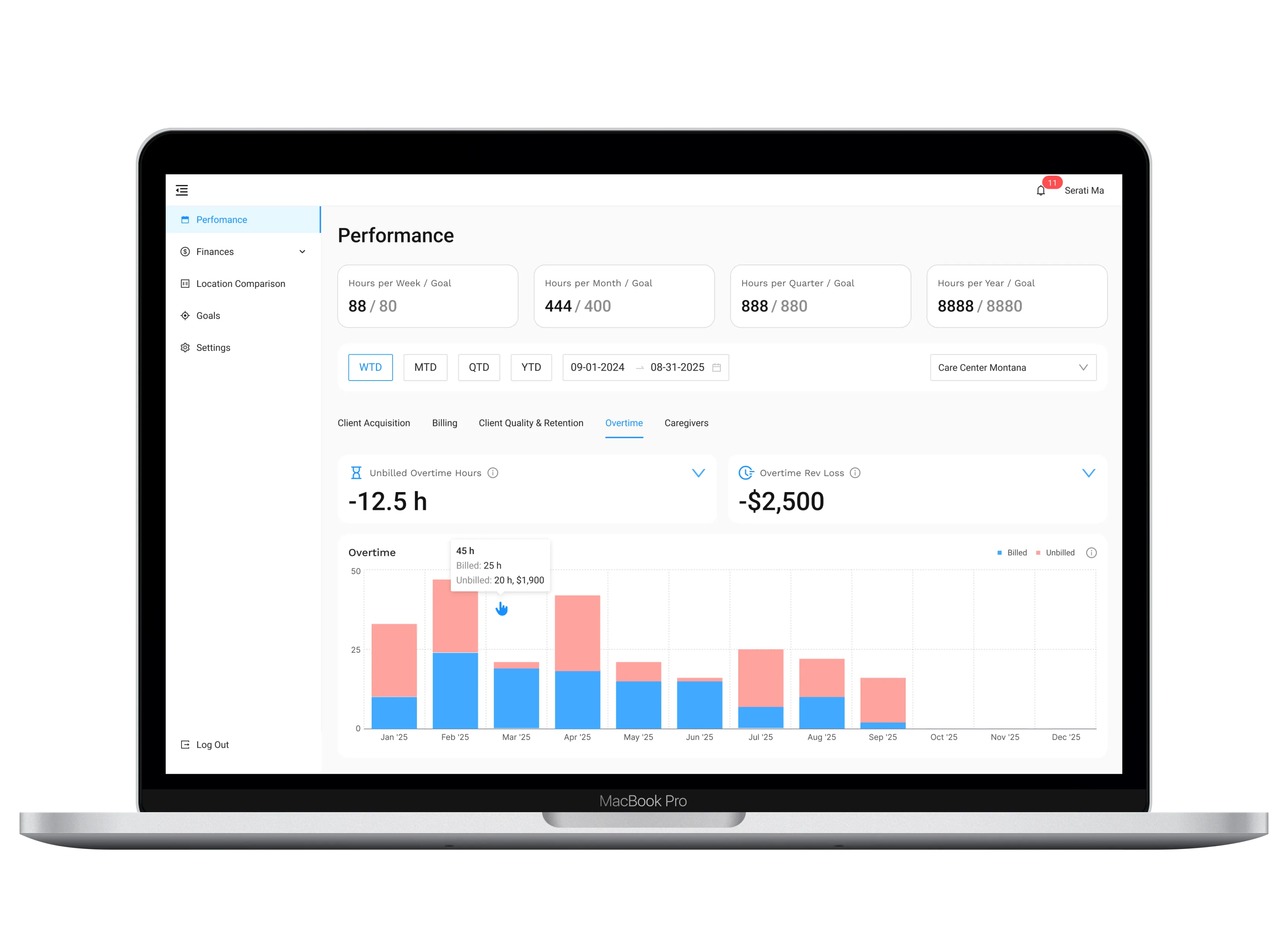
The team:
- Integrated the platform with WellSky Personal Care and QuickBooks, manual data collection was eliminated entirely
- Built a centralized dashboard with real-time visualization of key KPIs across all locations
- Implemented a role-based access system: schedulers, sales, and executives each see only the data relevant to their role
- Designed the architecture to support scaling from 4 to 6 locations without the need to rebuild the system
As a result, the client's team was freed from manual data collection and consolidation, significantly reduced the time spent on reporting, and gained a single point of control across all locations in real time. Leadership could now make decisions based on current data rather than manually compiled spreadsheets that were always slightly out of date.
But the most important outcome wasn't the platform itself. By shifting focus during the analysis phase, the client received not "better spreadsheets" but a tool that directly supports business growth and was ready to scale from day one.
What Mistakes Do Companies Make When Choosing an Outsourcing Partner?
Even the best team can't always compensate for mistakes made at the partner selection stage.
Here are the most common ones:
Choosing based on price alone. The lowest rate doesn't always mean the best investment — what seems like savings upfront often leads to significantly higher costs down the line.
Measuring success by the number of features. A long list of delivered functionality doesn't guarantee a successful product. What matters is the impact on business outcomes, not the volume of work completed.
Skipping the discovery phase. The urge to jump straight into development often leads to costly mistakes that could have been avoided with proper upfront analysis.
Trying to build everything at once. A backlog without clear prioritization leads to loss of focus, delays, and increased risk.
Treating the contractor as just an executor. The most value comes from a partner who thinks alongside you — not one who simply closes tickets.
How Can You Identify a Product-Minded Development Team?
The simplest way to find out is to pay attention to the questions the team asks during your first meetings. A strong product-minded team doesn't start with technologies, tech stack, or timeline estimates. It starts with the business.
If the first conversation includes questions about your users, success metrics, and risks, that's a good sign. If it jumps straight to technical details and pricing, that's worth noting.
Pay attention to whether the team asks things like:
- Who is the end user of the product?
- What business goals need to be achieved?
- How will project success be measured?
- Which features are critical for the MVP?
- What risks could affect the outcome?
- What happens after launch?
- What metrics need to be tracked?
The more a team talks about goals, users, and outcomes, the more likely they are to act as a true partner rather than just an executor. To make that evaluation easier, we've put together a short checklist.
Checklist
Choosing the right technology partner is one of the most important decisions you'll make for your product. Use this checklist during your first meetings with a potential team. The more boxes that check out in practice, the higher the chance you've found a partner who's genuinely thinking about your business, not just closing tickets.
- Asks about business goals and users first, technology comes second
- Discusses how project success will be measured: metrics, KPIs, expected outcomes
- Helps prioritize the backlog and explains the reasoning behind what to tackle first
- Willing to challenge specific requirements if they don't create real value
- Proposes alternative solutions rather than just executing what's been asked
- Identifies risks and potential issues before development starts
- Talks about ROI and business impact, not just hours and cost
- Plans for what happens after launch: support, iterations, product evolution
If most of these don't match what you're seeing, it might be worth considering other partners.
Key Takeaways
- Traditional outsourcing focuses on delivering requirements, while product thinking focuses on business outcomes.
- Product-minded teams prioritize ROI, retention, user adoption, and time-to-market.
- Discovery and business analysis help reduce risks before development starts.
- Challenging requirements can prevent unnecessary spending and accelerate product launches.
- Enterprise, SaaS, and B2B projects benefit significantly from product thinking because business processes and scalability are directly affected by development decisions.
- Choosing a technology partner should involve evaluating strategic thinking, not only technical capabilities.
Conclusion
The market has changed. Companies today aren't just looking for contractors who write clean code, they're looking for partners who understand their business, their goals, and can help them make better decisions.
That's exactly what product thinking enables. Instead of focusing on executing individual requirements, the team starts with business context, works with success metrics, and evaluates how each decision will affect the end result. This approach allows for faster hypothesis testing, more effective use of budget, and a lower risk of building functionality nobody actually needs.
Product thinking isn't limited to startups or in-house product teams. It works just as well in outsourcing projects, especially in Enterprise, B2B, and SaaS environments where mistakes in prioritization can be costly.
The greatest value a technology partner can offer isn't delivering every request a client makes. It's helping them figure out which decisions actually create business value and which ones aren't worth building at all. That's why product thinking has become a genuine competitive advantage for outsourcing teams and one of the key criteria businesses use when choosing a partner.
FAQ
What is product thinking in software development?
Product thinking is a development approach that prioritizes business goals, user needs, and measurable outcomes. Instead of focusing solely on feature delivery, teams evaluate how every decision contributes to product success.
What is the difference between outsourcing and product development?
Traditional outsourcing focuses on executing requirements provided by the client. Product development focuses on identifying the best solution to achieve business objectives, even if that means changing or removing planned features.
Why do outsourcing projects fail?
Many outsourcing projects fail because of poor prioritization, lack of business analysis, overloaded backlogs, and excessive focus on feature delivery rather than business outcomes.
How do I choose the right software development partner?
Look for a team that asks about business goals, users, KPIs, risks, and product strategy before discussing technology choices or development estimates.
Can an outsourcing company provide product strategy?
Yes. Mature outsourcing companies often combine software engineering, business analysis, UX expertise, and product management to help clients make better product decisions.
What metrics matter most in software product development?
Common metrics include ROI, user adoption, retention rate, conversion rate, time-to-market, customer acquisition cost (CAC), and operational cost reduction.