From Selling Hours to Selling Judgment: How AI Coding Agents Are Rewriting the Outsourcing Contract
September 17, 2026

Short answer: Hourly billing worked as a proxy for value while output scaled with human effort. AI coding agents break that link, the typing is no longer the expensive part. What stays expensive is deciding what to build, reviewing what the agent produced, and owning the consequences in production. The contract that fits this reality is outcome-based: defined deliverables, acceptance criteria, quality and security requirements, AI governance rules, and explicit accountability. Time & Material does not disappear. It stops being the only unit of account.
The conversation every CTO is now having
A familiar situation. You are paying for a team of six. Over a few months, output visibly increases. The team adopted Cursor, Claude Code, Copilot, and a set of internal agents. Tickets close faster. Pull requests get bigger. Documentation appears that nobody had time to write before.
Then the invoice arrives, and it looks exactly the same as last quarter.
This is not a billing dispute. It is a measurement problem. If one engineer can now do what took three, the hour has stopped being a unit of value and become a unit of attendance.
The market data points the same way. Gartner projects that by 2028, 75% of enterprise software engineers will use AI code assistants, up from less than 10% in early 2023. More pointedly, Gartner's May 2026 assessment of enterprise AI coding agents predicts that by 2027, more than 65% of engineering teams using agentic coding will treat the IDE as optional, shifting control, governance, and validation to automated platforms. Read that carefully: the forecast is not about faster typing. It is about where control and validation live.
This article explains why that shift changes the commercial model between client and vendor, what an AI-era Statement of Work should contain, and how to tell in a single call whether a vendor is selling you hours or selling you judgment.
Why hourly billing stops reflecting real value in the AI era
Time & Material made sense for a reason. For thirty years, software output scaled roughly linearly with human effort. Two engineers produced about twice what one produced. Estimates were imperfect but not absurd. Under those conditions, hours were a fair proxy: both sides could observe them, and neither side could easily game them.
AI breaks the proportionality in specific, uneven places:
- Boilerplate, scaffolding, and CRUD layers are generated in minutes.
- Test coverage that used to be deprioritised now gets written because it is cheap.
- Documentation and migration scripts stop being a budget line.
- Mechanical refactoring across hundreds of files becomes a review problem, not a typing problem.
Note what is not on that list: choosing the data model, deciding whether to split a service, judging whether a 40% latency improvement is worth a new dependency, or deciding what to do when the agent's solution works and is still wrong for your roadmap.
So the cost curve has changed shape. Cheap work got much cheaper. Expensive work stayed expensive, and now represents a much larger share of the bill.
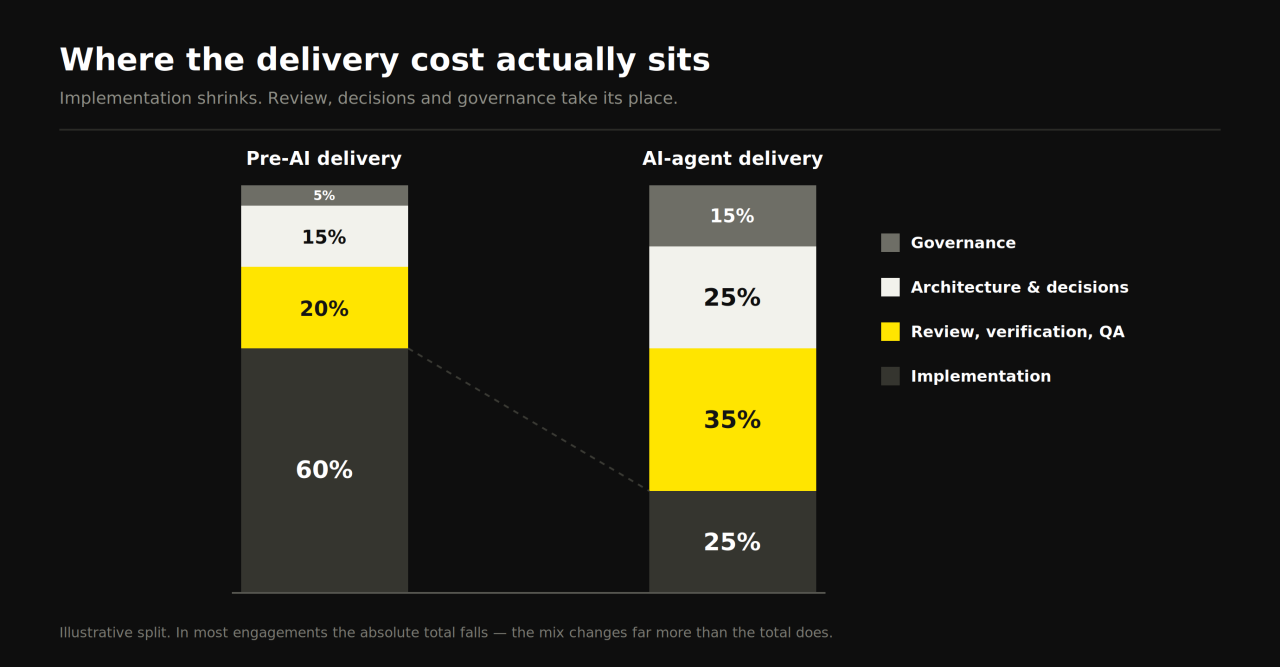
The uncomfortable corollary for vendors: under T&M, efficiency reduces revenue. A vendor that automates 40% of its own work and bills honestly earns 40% less for the same delivered outcome. That is a structural conflict of interest, and clients have started to notice it.
AI doesn't replace engineers, it changes what clients are paying for
The loudest version of this argument ("AI writes the code, so you don't need the vendor") collapses on contact with production data.
The 2025 DORA report found that 90% of technology professionals now use AI at work and more than 80% believe it has increased their productivity, while AI adoption continued to correlate with lower software delivery stability: more change failures, more rework. DORA's framing is that AI is an amplifier. It accelerates teams with strong testing, version control, and review practices, and it magnifies dysfunction in teams without them.
Belief is also a poor guide. METR's randomized controlled trial (July 2025) had 16 experienced open-source developers complete 246 real tasks in their own repositories, randomly assigned to allow or disallow AI tools. Developers predicted a 24% speedup, reported a 20% speedup afterwards, and were measured as 19% slower. METR itself published a follow-up in February 2026 noting selection effects and changing the study design, so this is one snapshot, not a law of nature. But the perception gap it documented is the point: self-reported productivity is not evidence, and a contract that pays for self-reported effort is buying a number nobody can verify.
Then there is security. Veracode's 2025 GenAI Code Security Report tested output from more than 100 LLMs across 80 security-relevant coding tasks in Java, Python, C#, and JavaScript. In 45% of cases the generated code introduced an OWASP Top 10 vulnerability; Java failed roughly 72% of the time. The report's most important finding for a CTO is not the headline number but the trend: larger and newer models did not produce meaningfully more secure code. This is structural, not a temporary gap that the next release will close.
And code composition drifts. GitClear's analysis found copy-pasted code rising from 8.3% to 12.3% of commits between 2021 and 2024, while refactoring activity fell from roughly 25% to under 10%. Volume up, consolidation down. That is a maintenance bill arriving later.
None of this says AI is not worth using. We use agents on every engagement. It says the value of a partner moved from producing code to deciding about code, and that an AI agent does not: make architectural trade-offs, weigh business context, sign off on a release, or answer to your board when a breach happens.
The new value: judgment, governance and accountability
Technical judgment
Technical judgment is the set of decisions that are cheap to make and expensive to reverse. Which boundaries the system has. Which database. Whether to accept coupling now to ship this quarter. Which technical debt is a deliberate loan and which is negligence.
An agent will happily give you three working implementations of the same endpoint. All three pass tests. One creates an N+1 query that only appears at 50,000 records. One makes the module untestable. One is right. Choosing correctly requires knowing the load curve, the roadmap, and the team that will maintain it in eighteen months, context that lives in the engagement, not in the prompt.
Code review and quality control
When generation is cheap, review becomes the bottleneck and therefore the product. DORA's 2025 research found that 30% of developers report little or no trust in AI-generated code, and that time saved in creation is often reallocated to verification and prompting overhead. Verification is a different cognitive task from writing, and it is the one the client is actually buying.
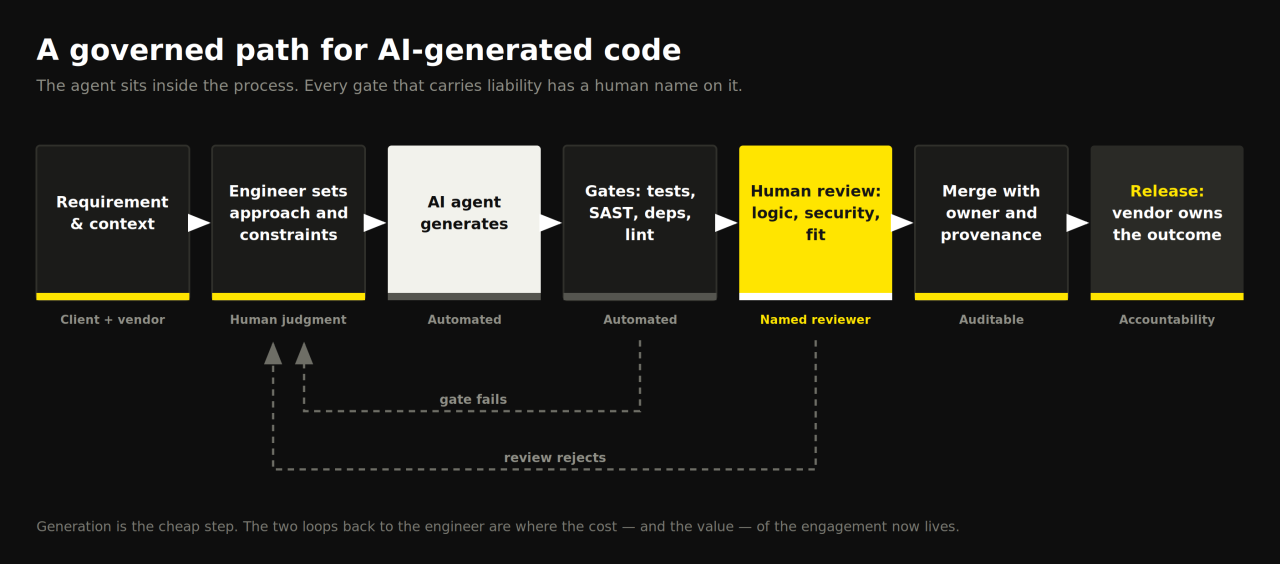
Practical markers of a mature review process: a human owner named on every merge regardless of who wrote the code; security review that is a gate, not a suggestion; and review of intent, not just diff correctness, does this change belong in this system at all?
AI governance
AI governance is the written answer to "how does AI get used on our codebase, and how would we prove it?" At minimum it covers:
| Governance area | What it answers |
|---|---|
| Tool policy | Which agents and models are approved, and in which environments |
| Data handling | What may be sent to a third-party model; what must stay in a private perimeter |
| Provenance | How AI-assisted changes are identified and traceable |
| Human sign-off | Who approves AI-assisted code, and at what thresholds |
| Security gating | SAST/dependency scanning applied to generated code before merge |
| Audit | What is logged, retained, and reportable to the client or a regulator |
| Documentation | What must be written down so knowledge survives the engagement |
Enterprise buyers increasingly audit exactly this. In regulated sectors it decides whether a deal closes at all, and it is a direct input to GDPR Article 28 processing agreements, SOC 2 evidence, and customer security reviews.
Accountability
"The code was written" and "the result is guaranteed" are different products with different prices.
Accountability is the promise that someone is responsible when the release slips, the integration breaks at 2 a.m., or a generated dependency turns out to be abandoned. It cannot be automated, it cannot be delegated to a model, and it is the single hardest thing to buy by the hour, because an hourly contract explicitly prices input, not result.
Case: what 315 hours taught us about the value of hours
Type of work: internal back-office platform (ERP-style), replacing nine third-party SaaS tools for a 50-person services company. Architecture: single internal application with a shared identity and permissions layer, REST integrations to calendar, email, and accounting, and a common data model across CRM, project, and finance entities. Scale: 9 replaced tools, ~50 internal users, three role groups (delivery, commercial, finance). Method: AI agents used throughout for scaffolding, integrations, and test generation; every decision about what to build made by humans first.
The problem. We were paying for a stack of disconnected subscriptions, meeting transcription, CRM, ATS, knowledge base, scheduling, task boards, test management, client portal, budget reporting. Per-seat pricing grew with headcount, and the tools did not talk to each other, so people reconciled data by hand.
What we did. We modelled each tool against real published vendor pricing for a 50-person company (checked August 2026) and against a build estimate at our internal $50/hour rate. Then we built the ones that survived the analysis.
The result. Nine tools, 315 development hours, $15,750 of build cost, against $63,683 of annual subscriptions. Net first-year effect: $47,933. Cumulative three-year effect: $175,299.
Here is the part that matters for this article. Look at what the hours actually predicted:
| Replaced tool | Build hours | Annual subscription avoided | Year 1 net | 3-year net |
|---|---|---|---|---|
| Knowledge base | 20 | $12,000 | +$11,000 | +$35,000 |
| Scheduling / booking | 10 | $4,608 | +$4,108 | +$13,324 |
| Client portal | 20 | $1,188 | +$188 | +$2,564 |
| Invoicing | 20 | $90 | −$910 | −$730 |
| Budget & P&L reporting | 140 | $25,000 | +$18,000 | +$68,000 |
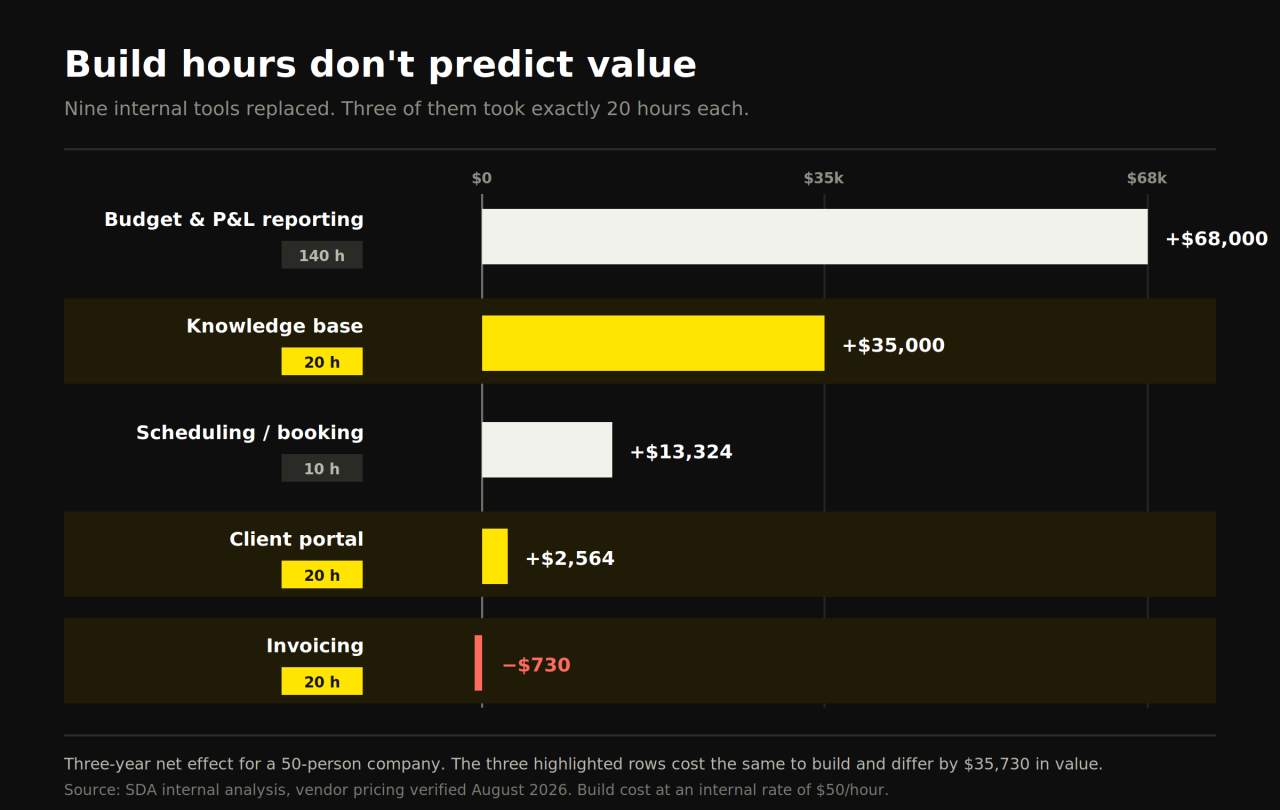
Three of those line items took the same 20 hours. Their value ranged from +$11,000 a year to permanently negative. The invoicing tool never pays back at all on pure economics, we built it anyway, for a reason that had nothing to do with hours: it was the only system that could not show payment status to project managers without manual reconciliation.
Lessons learned. The hours were the least informative number in the exercise. What created the value was the decision about which nine of twelve candidates were worth building, which one to build despite a negative ROI, and which to keep paying for. An agent could have built all twelve. It could not have told us which three to skip.
A second, client-facing example. On a healthcare analytics platform for senior care operators, a market intelligence product aggregating competitor pricing, occupancy, and facility performance, with integrations into external healthcare data providers and EMR systems, plus an LLM layer generating monthly summaries and recommendations, the client's summary of the engagement was not about delivery speed. It was that the team "considered how every decision would impact the entire product, not just the feature being built." That is a description of judgment being purchased, written by a buyer.
What an outcome-based Statement of Work looks like
An AI-era SOW is not longer. It moves its centre of gravity from effort described to result defined.
| Section | Purpose | Pre-AI SOW | AI-ready SOW |
|---|---|---|---|
| Deliverables | What exists at the end | "Development services" | Named artefacts, environments, docs |
| Acceptance criteria | How "done" is decided | Client sign-off, undefined | Testable conditions agreed up front |
| Quality requirements | Floor below which work is not accepted | Absent | Coverage, performance budgets, error rates |
| Security requirements | Non-negotiable controls | Generic clause | SAST/dependency gates, disclosure process |
| AI governance | Rules for AI use on the codebase | Absent | Tool policy, data rules, provenance, sign-off |
| Review process | Who checks what | Implicit | Named human owner per merge; escalation path |
| Documentation & handover | What survives the vendor | "Reasonable documentation" | ADRs, runbooks, onboarding path, knowledge transfer |
| Responsibility split | Who owns which failure | Blurred | Explicit per environment and per incident class |
| Change process | How scope moves | Hours added | Scope traded against defined outcomes |
The practical test: if your vendor disappeared tomorrow, does the SOW describe something a new team could verify and continue? If it only describes people and hours, it does not.
How to structure outcome-based pricing without losing flexibility
Outcome-based does not mean fixed-price-for-everything. Fixed price on an unknown scope is how both sides lose. In practice, five structures cover most engagements.
| Model | Works best when | Advantages | Risks | Good fit |
|---|---|---|---|---|
| Milestone-based | Scope is definable in 2–6 week chunks | Predictable cash flow; clear acceptance | Milestone gaming; disputes at the boundary | MVPs, platform migrations, integrations |
| Sprint-based outcomes | Direction is clear, details are not | Keeps agility; recurring checkpoints | Requires a disciplined product owner | Ongoing product development |
| Value-based | The business metric is measurable and attributable | Interests genuinely aligned | Attribution fights; needs mutual trust | Cost-reduction and automation work |
| Hybrid T&M + milestones | Mixed discovery and delivery | Flexible where unknown, firm where known | Complexity; needs clean scope boundaries | Most mid-sized engagements |
| Capped budget with defined outcomes | Client needs a hard ceiling | Budget certainty without fixed scope | Vendor absorbs overrun risk; may inflate the cap | Enterprise procurement, regulated buyers |
The pattern we see working most often is the hybrid: discovery on capped T&M because you cannot honestly price what you have not seen, delivery on milestones with acceptance criteria, and ongoing work on sprint outcomes. Budget impact is usually neutral-to-positive in year one and clearly positive in year two, mostly because rework drops when acceptance criteria exist in writing.
Questions that reveal whether a vendor sells hours or judgment
Use these on a call. You are listening for specifics, not enthusiasm.
| Question | Mature answer sounds like | Red flag |
|---|---|---|
| How do you measure developer productivity when AI is used? | Delivery metrics, change failure rate, rework rate, lead time, plus outcome acceptance | "Story points" or "we track utilisation" |
| How is AI-generated code reviewed? | Same gates as human code, plus named human owner; security scanning before merge | "Our seniors look at it" |
| Who approves AI-generated code? | A named role, with thresholds for when escalation is required | "The developer who used the tool" |
| How do you keep architecture consistent? | ADRs, architecture owner, review of intent not just diffs | "Everyone follows best practices" |
| What AI governance policy do you follow? | A written document they can send you today | "We're working on one" |
| How do you document AI usage? | Provenance in commits/PRs; auditable log; client-visible on request | Blank look, or "we don't distinguish" |
| What metrics besides billable hours? | Acceptance rate, defect escape rate, stability, time-to-restore | Only hours and headcount |
| How do you reduce AI-created technical debt? | Explicit refactoring budget; churn/duplication tracked | "AI code is clean" |
| What happens if AI-generated code causes a security issue? | Same liability as any code they shipped; incident process described | Any answer that shifts blame to the tool |
| What data leaves your perimeter? | Precise list of tools, data classes, and contractual limits | "Nothing sensitive, don't worry" |
The strongest signal is not the content of the answer, it is whether the vendor has a written answer. A team that has thought about governance has documents. A team that has not will improvise fluently.
Signs your outsourcing contract belongs to the pre-AI era
- The primary KPI is hours delivered or seats filled.
- The contract contains no mention of AI use at all meaning you have neither permitted nor prohibited it, and you cannot audit it.
- The review process is undefined, so accountability for generated code is ambiguous by construction.
- There are no quality criteria, so "done" means "the vendor says so."
- Security requirements are a single boilerplate clause.
- Success is measured by velocity rather than business outcomes.
- Documentation and knowledge transfer are described as "reasonable efforts."
- Efficiency gains flow entirely to one side, which means neither party has an incentive to raise the subject.
Each of these was survivable when output tracked effort. With agents in the pipeline, they are the exact places where risk accumulates quietly: unreviewed generated code, undocumented decisions, and a security posture nobody contractually owns.
Common mistakes when moving away from hourly billing
- Fixing the price before fixing the scope. Outcome-based pricing on an undefined outcome is just risk transfer with extra steps. Discovery stays on time-and-materials, capped.
- Writing acceptance criteria that are not testable. "High quality, scalable code" is not a criterion. "p95 under 300 ms at 10k concurrent sessions" is.
- Demanding an AI discount without changing the contract. If you want the efficiency gain, you have to redefine what you are buying. Cutting the rate while still paying by the hour just moves the conflict.
- Banning AI outright. It does not stop usage, it stops disclosure, and shadow usage is the worst of both worlds. DORA's data on unclear organisational AI stances points the same way.
- Treating governance as a document rather than a gate. A policy nobody enforces in CI is a liability, not a control.
- Forgetting the maintenance bill. Higher merge volume with lower refactoring is a debt schedule. Budget refactoring explicitly or pay for it later with interest.
- Measuring only throughput. Track change failure rate and rework alongside lead time, or you will optimise your way into instability.
The future of outsourcing is selling better decisions, not more hours
The direction of travel is not complicated. AI makes producing code cheaper and faster. Everything that cannot be automated gets relatively more expensive: architectural reasoning, technical leadership, risk management, quality control, accountability, domain expertise, and business context.
An outsourcing partner whose only product was throughput is now competing with a subscription. A partner whose product is judgment is selling the one thing that got scarcer.
For clients, the practical consequence is a change in diligence. The old question was "how many engineers do I get and at what rate?" The useful question now is "how does this team decide, verify, take responsibility, and can they show me the documents?"
Key recommendations
- Rewrite acceptance criteria before you rewrite the pricing model. Everything else depends on a testable definition of done.
- Add an AI governance section to your SOW covering tools, data, provenance, sign-off, and audit, even if your current vendor does not use agents heavily yet.
- Move to a hybrid structure: capped T&M for discovery, milestones with acceptance criteria for delivery, sprint outcomes for ongoing work.
- Measure stability, not just speed: change failure rate and rework rate alongside lead time.
- Budget refactoring explicitly as a percentage of delivery, and track duplication and churn.
- Ask every vendor for their written AI policy. Treat the absence of one as a finding.
- Re-read any contract signed before 2024. It was written for a different cost structure.
Sources
- Gartner, Market for Enterprise AI Coding Agents (May 2026) — agentic coding, governance and validation shift.
- Gartner (April 2024) — 75% of enterprise software engineers using AI code assistants by 2028.
- DORA / Google Cloud, 2025 State of AI-assisted Software Development — adoption, trust, throughput and stability findings.
- METR, Measuring the Impact of Early-2025 AI on Experienced Open-Source Developer Productivity (July 2025) and study-design update (February 2026).
- Veracode, 2025 GenAI Code Security Report — security pass rates across 100+ LLMs.
- GitClear, code quality research on duplication and refactoring trends, 2021–2024.
- SDA internal analysis: replacement of nine SaaS tools with in-house systems, pricing verified August 2026.
FAQ
How should I structure a software outsourcing contract now that AI writes much of the code?
Define outcomes and acceptance criteria first, then pick a pricing structure that matches how certain the scope is. Add explicit sections for quality requirements, security gates, AI governance, review process, documentation and responsibility split. Keep time and materials for discovery, where nobody can honestly price the unknown.
Does hourly billing still make sense for AI-assisted software development?
For open-ended discovery, research spikes and support with unpredictable volume, yes. For defined delivery work it increasingly does not, because hours no longer correlate with delivered value and the model rewards the vendor for being slow.
What is an outcome-based software outsourcing contract?
A contract where payment is tied to defined, verifiable results, such as working functionality meeting agreed acceptance criteria, quality thresholds and security requirements, rather than to time spent. It usually combines milestones or sprint outcomes with a capped budget for uncertain work.
How can I measure the value of an AI-enabled development team?
Use delivery and stability metrics instead of effort metrics: lead time for changes, deployment frequency, change failure rate, rework rate, defect escape rate and acceptance rate against criteria. If the team's self-reported speed diverges from measured delivery, investigate the gap.
What should I include in an AI-ready Statement of Work (SOW)?
Approved tools and models, data handling rules for what may leave your perimeter, provenance requirements for AI-assisted changes, named human sign-off, mandatory security scanning before merge, audit and retention expectations, documentation standards, and a clear statement that vendor liability is identical regardless of how the code was produced.
How do I evaluate an outsourcing vendor that uses AI coding tools?
Ask for the written AI policy, the review process, the metrics they report besides hours, and their incident process for security issues in generated code. A mature vendor answers with documents and named roles. An immature one answers with reassurance.
Will AI reduce outsourcing costs or simply change pricing models?
Both, unevenly. Unit costs for well-defined implementation work fall, while architecture, review, security and accountability hold or rise as a share of the bill. Total project cost often falls, but the pricing model has to change for that saving to reach the client rather than being absorbed as vendor margin.
What responsibilities should remain with the vendor when AI is used?
All of them. Architectural decisions, code review, security, delivery dates and production behaviour are vendor responsibilities regardless of what produced the code. Any contract that treats AI output as a shared-risk category is transferring liability to the buyer.