Which Business Agency Do You Actually Need? The Best IT, Design, Marketing & Consulting Firms for 2026
July 23, 2026
Oleksandr Shubin | Founder & CEO at SDA

It's no longer enough for modern businesses to simply find developers, designers, or marketers. The companies scaling fastest are working with partners capable of solving specific business challenges: launching products, improving conversion, automating processes, entering new markets, and reducing the risk of costly decisions.
The key question today isn't "Do we need an external partner?" but "What type of expertise does the company need right now?"
Introduction
Just a few years ago, companies typically worked with individual contractors for specific tasks.
Need a website — hire a web studio.
Not enough developers — look for an outsourcing team.
Need traffic — turn to a marketing agency.
Need market research — bring in a consulting firm.
This approach worked as long as business processes remained relatively simple. But modern companies face far more complex challenges. Launching a new product, scaling sales, or entering a new market rarely depends on just one area of expertise anymore.
For example, even the best product may fail to gain demand without the right marketing strategy. At the same time, large marketing budgets won't deliver results if the user experience or internal processes remain inefficient.
That's why more and more companies are looking for partners who help them achieve specific business outcomes:
- launch products faster;
- scale sales;
- improve conversion;
- automate operational processes;
- enter new markets;
- minimize the risk of costly decisions;
- make data-driven decisions.
Ultimately, the question is no longer whether a company needs an external partner. The question is what type of expertise the business needs at its current stage of development.
Why Companies Are Increasingly Turning to Specialized Agencies
Growing competition, a shortage of experienced specialists, and constant pressure to launch products faster are pushing companies to rethink how they build their teams.
Shortage of strong specialists
Finding experienced engineers, designers, marketers, or analysts can take months. For many companies, time becomes more costly than the hiring process itself.
High cost of in-house teams
Building a full in-house team requires significant investment: recruiting, onboarding, salaries, management, training, and retention.
In some cases, companies gain access to the expertise they need much faster and more affordably through external partners.
The need to launch new initiatives quickly
In today's environment, speed has become a competitive advantage. Businesses need to test new products, enter other markets, and implement changes faster than a traditional hiring process allows.
Expertise "on demand"
Not every company needs a permanent team for SEO, UX, business analytics, or digital transformation. Instead, access to specialized expertise exactly when it's needed allows for far more efficient use of resources.
Different Business Challenges Require Different Partners
One of the most common mistakes is looking for a single universal contractor for every task.
In reality, different problems require different types of expertise.
| Business Task | Type of Partner |
|---|---|
| Need to quickly strengthen the development team | IT Talent Partner |
| Need to improve brand and UX | Design Agency |
| Need to automate processes | Digital Transformation Partner |
| Need to increase sales | Marketing Agency |
| Need to assess risks or find growth points | Business Consulting |
The best results are usually achieved when a company combines several areas of expertise, rather than trying to solve every problem with a single tool.
Where SDA Fits In
While many agencies specialize in a single discipline, some business challenges span several areas at once.
A company may need to validate a product idea, redesign user flows, strengthen its engineering team, automate internal operations, and integrate AI into existing workflows — all within the same initiative. Coordinating several vendors for interconnected work often creates additional overhead, slows decision-making, and increases delivery risk.
This is where SDA fits.
SDA is a software development and AI solutions company that helps businesses solve operational and product challenges through a combination of business discovery, engineering, AI integration, process automation, and long-term product development.
Rather than focusing on technology alone, the team starts by understanding business objectives, identifying bottlenecks, and selecting the right technical approach. Depending on the project, this may involve building custom software, modernizing an existing platform, automating manual workflows, strengthening an internal engineering team, or implementing AI where it delivers measurable value.
The company works primarily with startups, scale-ups, and established businesses across Healthcare, Manufacturing, FinTech, EdTech, marketplaces, and other B2B industries, supporting clients from early product strategy through launch, scaling, and ongoing development.
Best For
Companies looking for a long-term technology partner that combines software engineering, AI implementation, automation, and product thinking to solve complex business challenges.
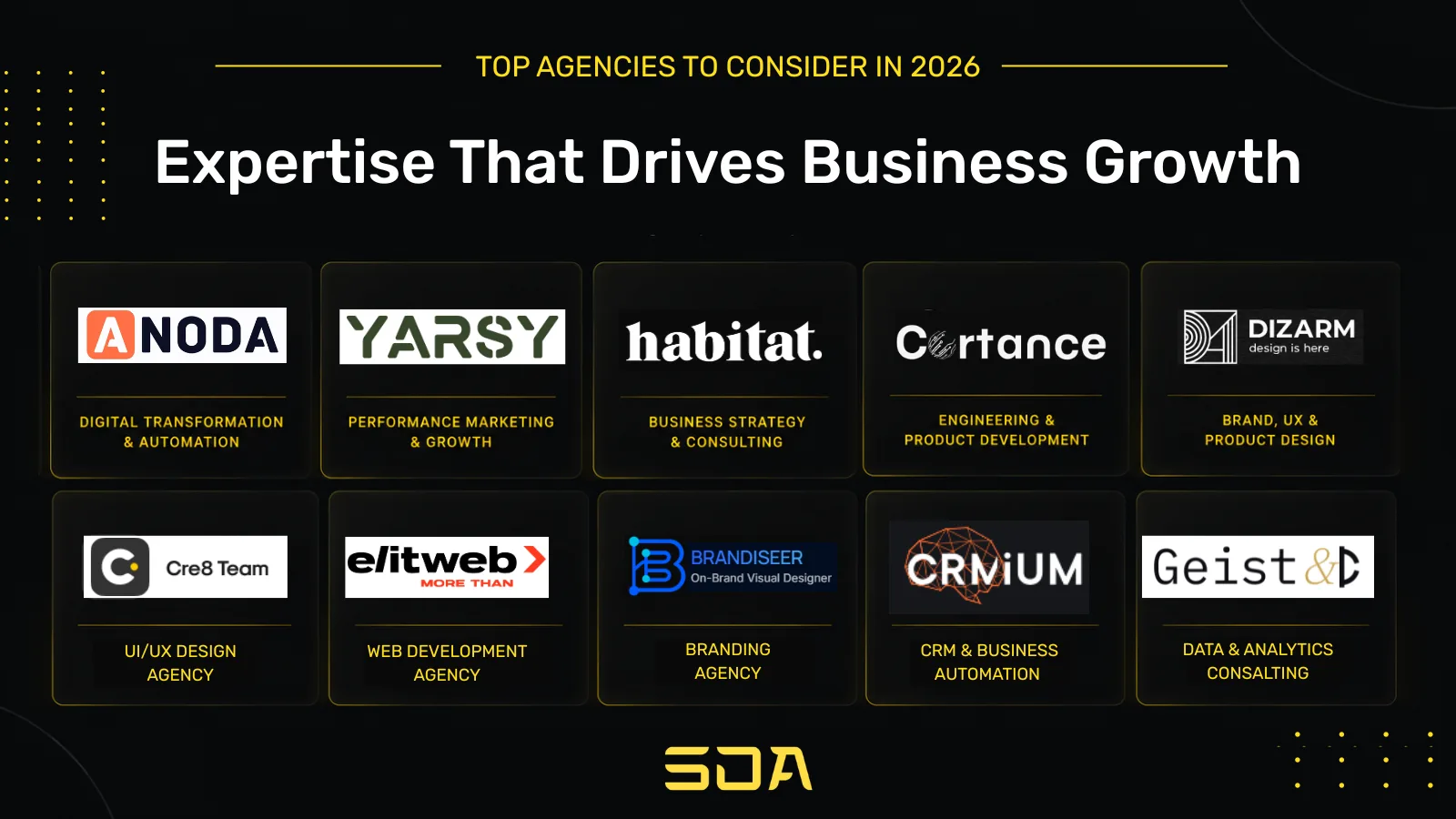
Top Agencies to Consider in 2026
Every business goes through different stages of development. At one stage, a company needs a strong development team; at another, it needs to rethink its brand, automate internal processes, scale marketing, or prepare to enter new markets.
That's why a truly universal partner, one equally good at solving any task, barely exists. A far more effective model is one where a company brings in narrowly focused experts in the areas where they can deliver the most value.
Below is a curated list of companies, each specializing in a distinct area of business development.
Brand, UX & Product Design
ANODA — UX Design for Complex SaaS Products
For SaaS products, good interface design isn't just a matter of aesthetics. UX quality directly affects onboarding speed, user retention, conversion to paying customers, and the volume of support requests.
ANODA specializes in UX/UI design for complex digital products. The team works primarily with SaaS, FinTech, AI, Web3, and B2B platforms, helping companies build interfaces that stay intuitive even with extensive functionality.
Unlike agencies that focus solely on visuals, ANODA starts its work with user research, business goal analysis, and building product logic. This approach doesn't just refresh the design, it improves key product metrics, from user activation to conversion rates.
The company has experience working with international SaaS products, enterprise platforms, and AI solutions, and regularly publishes expert content on digital product design.
Best For
SaaS, AI, and B2B companies looking to improve UX, boost conversion, and make a complex product simpler for users.
YARSY — Digital Systems Designed Around Business Goals
Not every business problem is solved with a new website or mobile app. Often the main obstacle is manual processes, a lack of transparent analytics, or the growing complexity of managing an expanding company.
YARSY specializes in building digital systems that help businesses work faster, make data-driven decisions, and scale their operations.
Before starting any project, the team identifies which specific business metrics need to improve: increasing sales, boosting conversion, automating processes, improving the customer journey, or simplifying internal team collaboration.
From there, a solution is designed — ranging from UX/UI and corporate portals to SaaS platforms, client dashboards, and automation systems.
It's this combination of business analysis, UX, automation, and technical implementation that allows the company to build not just standalone digital products, but complete systems for business growth.
Best For
Companies looking to digitize processes, automate operations, or build internal business systems.
Habitat — Product Design for AI-First Companies
The AI product market is growing so fast that for many startups, the biggest challenge isn't building the model, it's building a product that investors and early customers will trust.
Habitat specializes precisely in this area. The team works with AI-native startups, helping turn complex technology into clear digital products through product thinking, UX/UI, branding, and web design.
Unlike classic design agencies, Habitat treats brand, product, and website as a single system. The work doesn't end with mockups in Figma, the team stays with the project through to launch. This matters especially for AI companies preparing for fundraising or their first major contracts, who need to look mature even before the product reaches full functionality.
Habitat's clients include Revo.ai, Bagel AI, Baselane, Feeds.ai, and other tech companies operating in international markets.
Best For
AI startups and tech companies developing complex digital products, preparing to raise investment, or looking to build a strong product ecosystem.
Cre8 Team — UX/UI Design for Complex Digital Products
As a digital product matures, its interface stops being just a "pretty shell." As the number of features, user scenarios, and roles grows, UX determines how easily people can interact with the product, and whether it can scale without losing usability.
Cre8 Team specializes in UX/UI design for complex digital products. The agency works with SaaS platforms, CRM and ERP systems, web and mobile apps, marketplaces, eCommerce solutions, and enterprise products where balancing functionality, ease of use, and business goals is essential.
Beyond UX/UI design, the team helps with UX research, audits, redesigns, branding, and graphic design, supporting the product across different stages of its development. Over six years, Cre8 Team has completed more than 250 projects for over 100 clients across various countries, working with companies in EdTech, Healthcare, FinTech, AI, DefenseTech, eCommerce, and other sectors.
The defining feature of Cre8 Team's approach is combining deep UX expertise with an understanding of digital product logic. The team designs interfaces that help users reach their goals faster, while helping businesses improve product efficiency and support further scaling.
Best For
SaaS companies and digital product owners building or growing complex web or mobile solutions who need UX/UI design built around business goals and real user scenarios.
DizArm — Where Brand Strategy Meets Product Thinking
Many companies start a redesign wanting to simply "refresh the website." In reality, the problem is often not visual, it's that the brand doesn't clearly communicate its value, and digital channels operate in a disconnected way.
This is exactly where DizArm starts its work. The agency combines brand management with product thinking, helping businesses build a system where brand, UX, communication, and touchpoints all work toward a shared outcome.
The team works on Brand Strategy, Go-To-Market strategies, Customer Experience, UX/UI, and CRO, focusing not just on the product's appearance but on business metrics.
Among the company's clients are Young Business Club, Pizza Day, Mozzarella, Mother and Child, and other brands going through a scaling stage or repositioning.
Best For
Companies preparing for a rebrand, launching a new product, or aiming to improve conversion through a stronger brand and user experience.
Engineering & Product Development
Cortance — Flexible Access to Verified Engineering Talent
Even a successful product can lose momentum if a company can't scale its technical team fast enough. Hiring strong engineers often takes months, while the need for additional resources tends to arise much sooner.
Cortance helps solve this problem through its own marketplace of verified developers offering resources on a flexible basis and with the possibility to buy them out. Unlike classic freelance platforms, the company uses multi-stage vetting, matching, and hiring processes to find specialists who fit not only the technical requirements but also the team's culture.
The company provides access to engineers mostly from Ukraine and Europe and works across areas such as Front-end, Back-end, Full Stack, DevOps, Cloud, Data Science, and GenAI.
Cortance has particularly strong experience working with startups and product companies in SaaS, FinTech, Healthcare, Retail, B2B, and B2C.
What sets Cortance apart
- its own public marketplace where you can browse best fit candidates based on your requirements instead of a freelance model or overpriced software development providers;
- 5-stage engineers verification;
- onboarding in 48 hours from receiving request, which means fast team scaling;
- flexible specialist engagement without long-term contracts;
- a focus specifically on product and startup companies.
Best For
Companies that need to quickly strengthen their engineering capacity without a complicated hiring process or permanent hiring commitment.
Marketing & Growth
Elit-Web — Performance Marketing Built Around Business Results
Many companies invest in marketing but don't always see predictable revenue growth. High traffic or a large number of leads don't guarantee profitability if marketing isn't tied to business goals.
This is exactly what Elit-Web builds its work around. The company specializes in performance marketing and helps businesses grow revenue through a comprehensive approach to digital promotion.
The team works across SEO, PPC, SMM, content marketing, web analytics, CRO, and GEO (Generative Engine Optimization) — optimizing brand visibility in AI search responses. Rather than treating marketing channels separately, Elit-Web looks at the entire customer acquisition system, analyzing the user journey from first contact to repeat purchase.
Over more than 15 years, the company has delivered more than 2,500 projects for businesses of various sizes, including DILA, Sport Life, UNIQA Ukraine, ATB, Avrora, and hundreds of international companies.
What sets Elit-Web apart
- a performance-driven approach rather than a focus on traffic alone;
- strong analytical expertise;
- work grounded in ROI and unit economics;
- a comprehensive digital strategy;
- experience across most modern industries.
Best For
Companies looking to scale sales, improve the efficiency of marketing channels, and make data-driven decisions.
Brandiseer — Consistent Brand Execution, Automated
Having a strong brand identity is only half the challenge, the other half is executing it consistently across every platform, every post, every asset, without needing a designer for each one.
Brandiseer solves this with an AI platform that learns a business's existing brand identity directly from their website or brand guidelines, and then generates on-brand marketing materials automatically, social posts, product visuals, ad creatives, and more, all consistently matching that established style.
Unlike generic AI image tools, Brandiseer doesn't require re-explaining brand style with every prompt, and it isn't a one-off image generator. It's built as ongoing brand infrastructure: businesses and agencies use it to produce a steady stream of on-brand content in minutes instead of days, at a fraction of the cost of traditional design work.
Best For
Businesses and marketing agencies that already have an established brand and need to execute visual content consistently and at scale, without expanding a design team.
Business Systems & Automation
CRMiUM — Turning Business Processes Into Scalable Systems
As a company grows, so does the volume of operational work. Data gets scattered across different services, managers perform dozens of manual actions, and leadership finds it increasingly difficult to get a complete picture of the business.
This is the stage at which many companies start reviewing their internal processes.
CRMiUM specializes in business process redesign and operational transformation bringing it to life through CRM and ERP solutions.
The team starts by analyzing existing processes, identifying bottlenecks, and redesigning how the business operates. Then build the technical solution around that.
This approach is especially valuable for companies that have already passed their initial growth stage and now need greater operational efficiency.
Best For
Companies that have outgrown their current tools and need operational clarity to scale through CRM and ERP built around their processes.
Business Strategy & Research
Geist&D — Grounding High-Stakes Decisions in Reality
The most expensive mistakes are made before execution begins, at the moment a decision is taken. A new market, a major raise, an acquisition, a product bet: founders and investors bring in Geist&D when the call is hard to reverse.
Geist&D works with founders, investors, and C-level roles to see the situation as it is. The agency maps the opportunity, the risk, and the path to growth, combining market research, customer intelligence, due diligence, business-process analysis, and hypothesis testing, and it assesses how ready a business is for AI transformation.
The deliverable is a decision made well and clarity about next steps. Geist&D stays through it, helping interpret findings alongside the client and build them into the plan the business acts on.
For 11 years, the experts of the Geist&D team have worked across FinTech, eCommerce, Anti-Fraud, Supply Chain, Manufacturing, DefSec and more, with clients from regions like Scandinavia, the Baltics, DACH, and MENA, and countries like Ukraine, the US, and the UK. The agency's founder, Diana Dalkevych, consults and mentors the primary organization's stakeholders about their hardest calls, market entry, scaling, fundraising, and M&A.
What sets Geist&D apart
- end-to-end research and analysis, from desk and field methods to insight integration, as one process;
- risk assessment and due diligence woven through every activity — market intelligence, field testing and validation, decisions and planning;
- business analysis and change-management consulting for AI adoption, from integration through to full transformation;
- experience across both civilian and DefSec domains, carrying the best of each into the other.
Best For
Founders and investors preparing to scale, enter a new market, raise, or de-risk a decision that's hard to undo.
Each of the companies presented here solves different business challenges, so choosing a partner should start not with a list of services, but with a clear understanding of your own goals. One company may need an additional development team, another a brand refresh, process automation, or a strategy check before scaling.
In the next section, we'll look at the criteria that will help you evaluate a potential partner and determine whether they can become a long-term part of your business's growth.
Real-World Example: How Combining Different Partners Helps Businesses Scale
One of the biggest mistakes companies make is trying to solve every problem with a single contractor. In practice, business growth almost always requires a combination of several types of expertise.
Let's look at a hypothetical example of a B2B SaaS company developing a document workflow automation platform.
Starting Point
The company had:
- a finished product;
- a team of 12 employees;
- a steady stream of clients;
- plans to enter the European and U.S. markets.
But as the business grew, it began facing new challenges: the in-house team couldn't keep up with feature development, website conversion remained low, marketing campaigns were generating expensive leads, leadership lacked the data to evaluate new markets, and internal processes were starting to slow growth.
The Solution
Instead of looking for a single universal contractor, the company brought in several partners.
Strengthening the technical team
To scale development quickly, the company brought in a partner with access to verified engineers.
This cut down the time needed to find specialists, enabled faster feature releases, and avoided a lengthy hiring process.
Improving the user experience
A UX audit revealed that users were getting lost during the registration stage.
Restructuring the site, the customer journey, and the interface helped improve conversion and reduce user churn.
Optimizing marketing
The next step was work on SEO, PPC, and analytics.
The focus shifted from visitor volume to lead quality and the profitability of acquisition channels.
Automating processes
As the company grew, it began losing efficiency due to manual operations.
Automating internal processes and implementing dashboards helped leadership access up-to-date data for decision-making.
Strategic evaluation of new markets
Before scaling, the company conducted research into potential markets and analyzed the competitive landscape.
This allowed it to focus on the most promising segments and avoid unnecessary spending.
The Result
Over the course of a year, the company achieved faster product development, improved website conversion, higher-quality leads, greater operational efficiency, and reduced risk when entering new markets.
This example shows that scaling a modern business rarely depends on a single factor. The best results come when a company combines several areas of expertise.
Quick Comparison: Which Partner Fits Your Current Challenge?
| Business Challenge | Best-Fit Partner |
|---|---|
| Need to improve UX for a complex SaaS product | ANODA |
| Building an AI product and preparing to scale | Habitat |
| Want to improve UX or build a digital system | YARSY |
| Need to design UX/UI for a complex SaaS, CRM, or ERP | Cre8 Team |
| Planning a rebrand or new product launch | DizArm |
| Not enough experienced developers | Cortance |
| Want to increase sales through digital marketing | Elit-Web |
| Want to build a strong brand and positioning | Brandiseer |
| Planning to automate business processes | CRMiUM |
| Entering a new market or assessing risk | Geist&D |
| Need a long-term technology partner for product development, AI, and automation | SDA |
How to Choose the Right Partner for Your Business
Even the strongest agency can't guarantee success if its expertise doesn't match your current needs.
When choosing a partner, it's worth paying attention to several factors.
Industry expertise
Experience in your field helps a partner understand the specifics of your business faster and avoid common mistakes.
Relevant experience
It's important to evaluate not the number of case studies, but whether they've handled similar challenges.
For example:
- SaaS;
- eCommerce;
- FinTech;
- Healthcare;
- B2B services.
Communication and processes
The quality of a partnership largely depends on how transparently the work is organized: regular meetings, clear reporting, fast feedback, clear responsibilities.
Proven track record
Real, practical experience often speaks louder than presentations or a polished website.
Focus on business outcomes
A good partner doesn't think in terms of "completing a task," but in terms of:
- increasing profit;
- cutting costs;
- accelerating launch;
- improving conversion;
- reducing risk.
Common Mistakes Companies Make When Selecting an Agency
Choosing based on price alone. The cheapest option often turns out to be the most expensive in the long run, due to rework, delays, and lost time.
Focusing only on the portfolio. Impressive case studies don't always mean a partner can solve your specific problem.
Lack of clear goals. Without well-defined KPIs, even the best team won't be able to demonstrate the value of its work.
Searching for a universal contractor. Few companies can be equally strong in consulting, design, development, and marketing. More often than not, the best results come from combining several specialized partners.
Evaluating technical skills only. Business understanding, communication, and strategic thinking often influence the outcome just as much as technical expertise.
Conclusion
Today, companies rarely face just one challenge. Successful scaling requires a combination of technology, design, marketing, and strategic thinking.
The right partners help businesses launch products faster, use resources more efficiently, improve user experience, increase sales, reduce risk, make better-informed decisions, and build sustainable growth.
The strongest agencies today are no longer just task executors. They become an extension of the client's internal team, helping the business move forward faster and more predictably.
FAQ
When should you turn to an external partner instead of building an in-house team?
If you need niche expertise, a fast launch, or there's no case for maintaining a large permanent staff, working with an agency can be more effective and cost-efficient.
What type of agency is best suited for SaaS companies?
It depends on the current task. For scaling development, Cortance is a good fit; for UX and product experience, DizArm; for automation, YARSY; and for marketing, Elit-Web.
How do you evaluate an agency's expertise?
Look at their case studies, industry experience, client reviews, communication processes, and their ability to think in terms of business outcomes.
Can one company cover all of a business's needs?
In most cases, no. Companies achieve the best results by combining several areas of expertise.
What should you pay attention to during your first meeting with an agency?
A good partner will ask about goals, risks, metrics, and your business model, not just walk through a list of features or services.
Why is strategic consulting important before making major investments?
Market research and risk analysis help avoid costly mistakes and support better-informed decisions.